Flagship: Tuberous Sclerosis Complex
A child is born with a single change in one gene that can quietly seed growths across five organ systems — brain, heart, kidneys, skin, lungs. Naming it can take a family years of scattered specialist visits.
This program exists because clinicians asked for it. Shown the first three engines — genomics, interpretation, and therapeutic discovery — clinicians who care for these children asked one question: is there anything you could do for TSC? Everything below is the answer to that question. The factory was built to be general. The flagship was requested.
So this is the flagship: the entire HCLS AI Factory — genomics, imaging, clinical reasoning, and drug discovery — converging on one child in a single afternoon, on one $4,699 computer, open for anyone to run. TSC turned out to suit the factory unusually well — multi-system enough to exercise nearly every engine and agent, with a clean gene-to-drug mechanism — but that was what we found, not why we started. Decision support for a clinician — never a diagnosis on its own.
The flagship story in under a minute.
What TSC is, in plain terms
Tuberous Sclerosis Complex is a genetic condition — roughly 1 in 6,000 births — in which benign tumors (hamartomas) grow across many organs. One faulty gene, present from birth, expressed in five different organ systems over a lifetime. That is what makes it hard for families, and it is why answering it well needs genomics, imaging, neurology, cardiology, and pharmacology in the same afternoon rather than across four years of appointments.
One condition, the whole factory
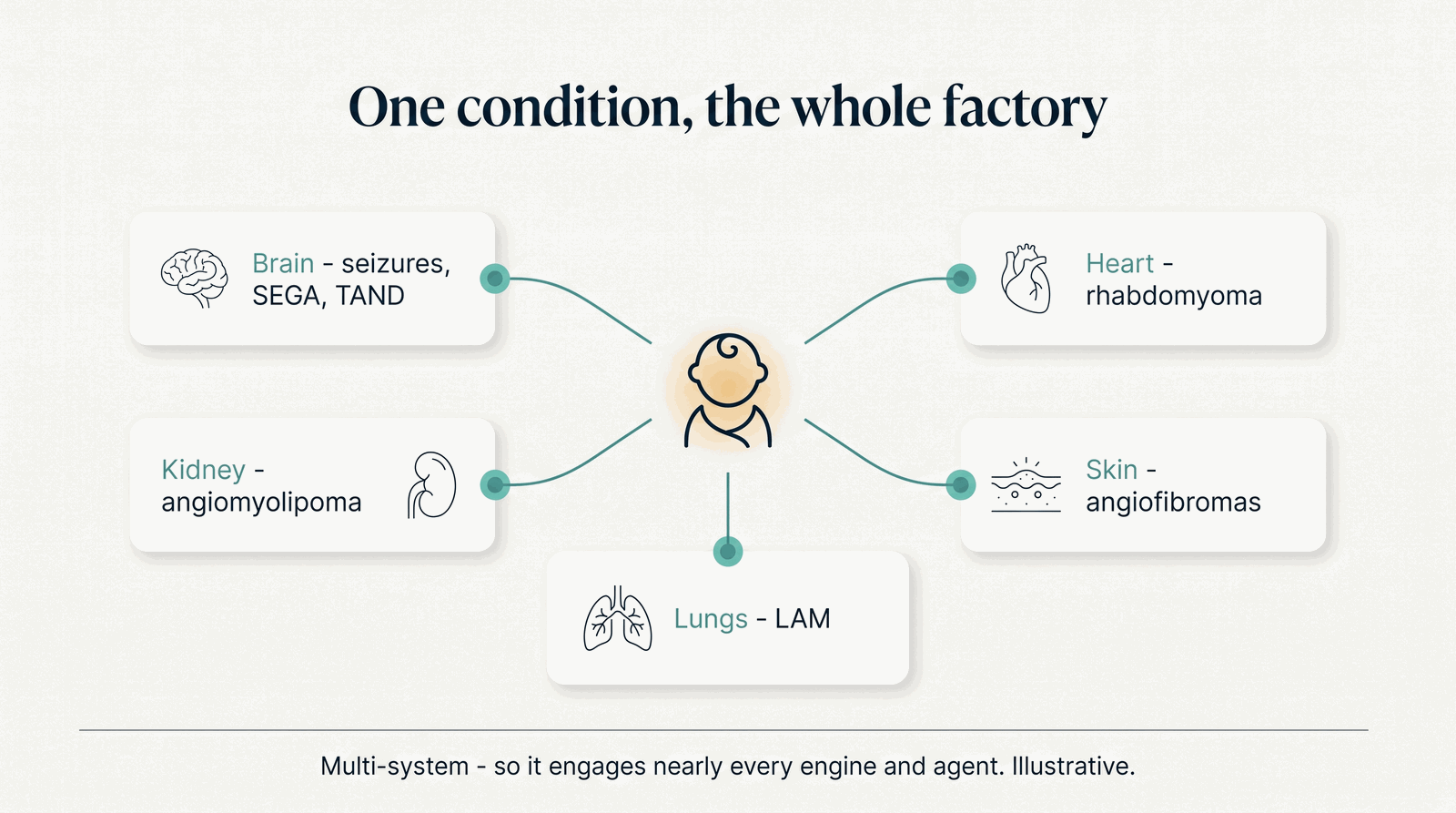
Illustrative.
TSC rarely stays in one place. It causes growths and problems in the brain (seizures, and effects on development and behavior), the heart, the kidneys, the skin, and the lungs — five organ systems at once. (The medical names a specialist would use: subependymal giant cell astrocytoma and TAND in the brain, cardiac rhabdomyoma, renal angiomyolipoma, skin angiofibromas, and pulmonary LAM.) That whole-body reach is exactly why one TSC patient needs the genomics, imaging, cardiology, pharmacogenomics, rare-disease, and neurology capabilities together — one child exercises almost the entire platform.
The gene-to-drug story
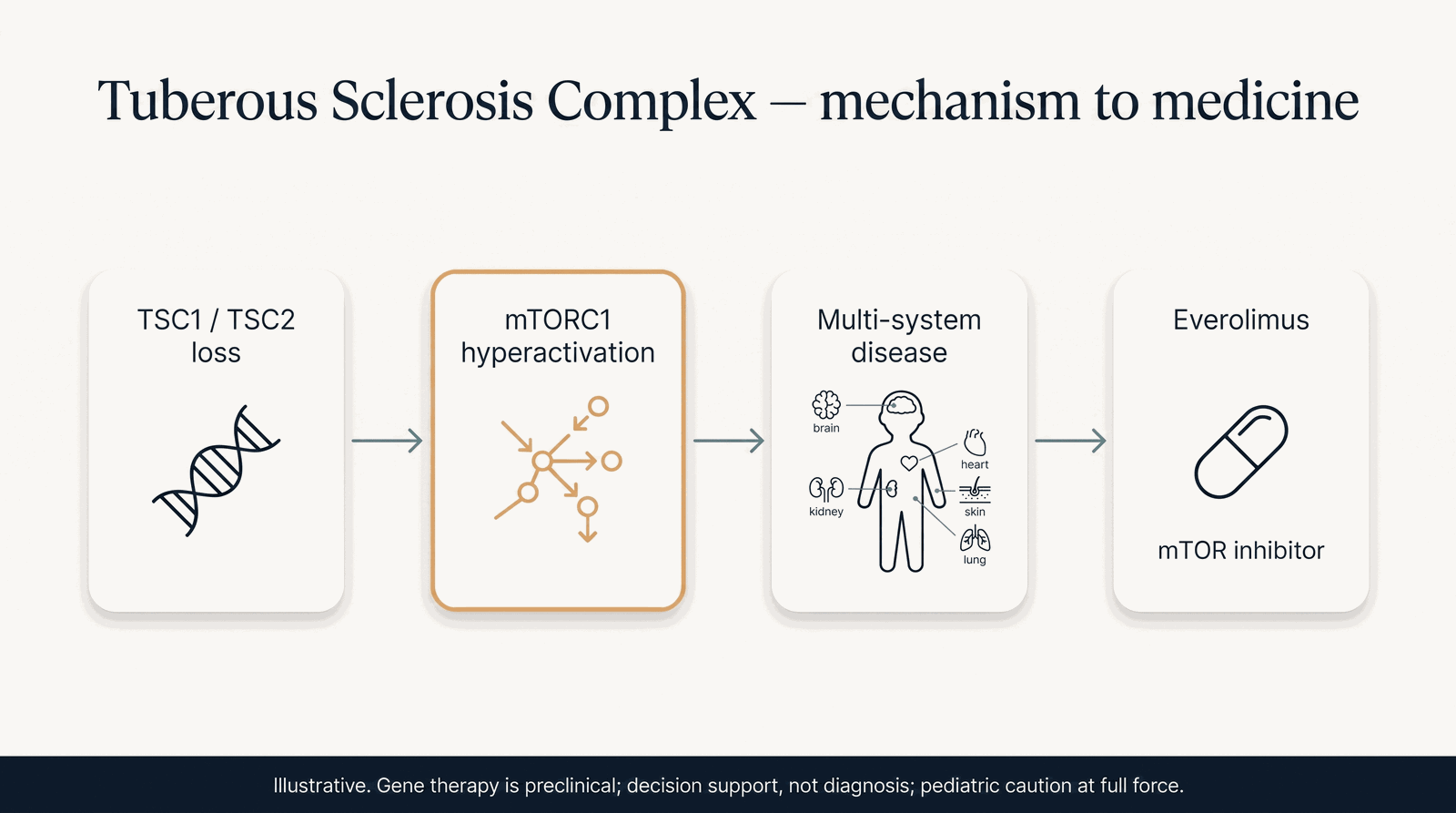
Illustrative.
TSC1 / TSC2 loss → mTORC1 hyperactivation → everolimus (an mTOR inhibitor). The TSC1 (hamartin) and TSC2 (tuberin) proteins normally form a complex that restrains mTORC1, a master regulator of cell growth. When a variant knocks that complex out, mTORC1 runs unchecked and hamartomas grow — so an mTOR inhibitor addresses the mechanism directly. Everolimus is real and FDA-approved in TSC (SEGA 2010, renal angiomyolipoma 2012, seizures 2018). The factory helps a clinician reason over a patient's variants, imaging, and phenotype to support that decision. It does not make it.
The full story — weight, compression, hope
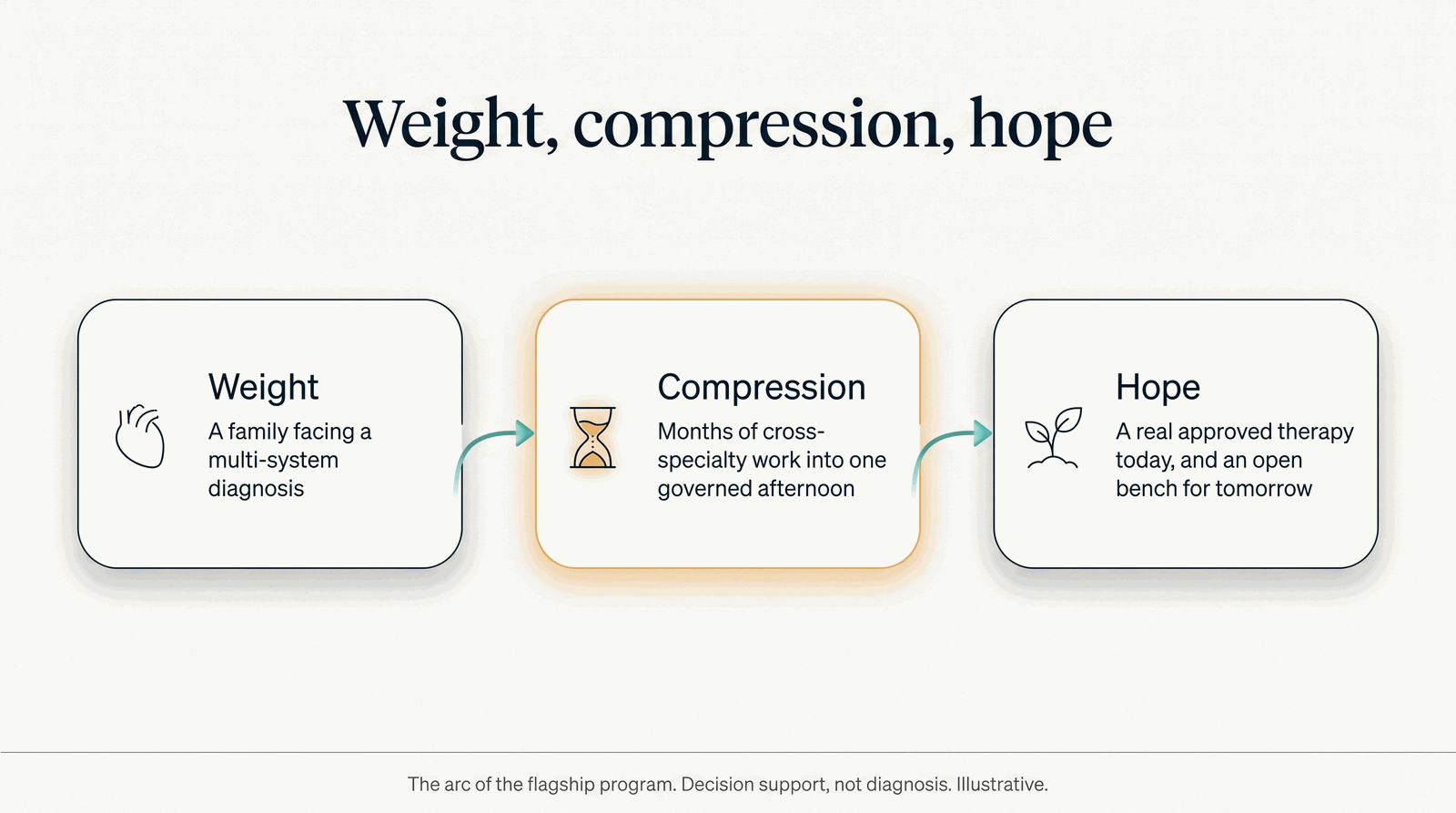
Illustrative.
The program is built as three beats: the weight of a family facing a multi-system diagnosis; the compression of months of cross-specialty work into a single, governed afternoon; and honest hope — a real, approved therapy today, and an open bench for what comes next.
Watch the whole journey — the diagnostic odyssey, and how the factory changes it:
Deep dive (~5 min): "One child, two journeys" — the diagnostic odyssey, the hamartin–tuberin / mTORC1 mechanism, mechanism-matched therapy, and designing a new precision molecule, shown with a real mTOR-structure animation. Decision support; molecule design is preclinical (illustrative structure).
How the factory composes here
A disease program is a vertical — a thin, deterministic orchestrator that composes the horizontal engines and intelligence agents for one condition. For a single TSC child, that looks like:
- Genomics. The Genomic Foundation engine calls variants from sequence and looks for the somatic mosaicism that standard germline pipelines miss — a genuine TSC diagnostic trap.
- Interpretation. Claude, the reasoning layer, weighs the variant against ACMG criteria and ClinVar and ties the scattered findings back to one mechanism; the Rare Disease and Pharmacogenomics agents add HPO phenotype matching and mTOR-inhibitor dosing context.
- Structure & discovery. For the drug side, the Therapeutic Discovery engine generates and docks candidate molecules against the mTOR pathway — preclinical design, not a therapy. Co-folding the top candidate with Chai-1 as an independent structural check is planned, not live; when it stands up it will run by elastic burst to a remote GPU.
- Surveillance. The Tuberous Sclerosis engine's disease-specific agents — variant curator, phenome mapper, trajectory modeler, TAND surveillance, therapeutics strategist — turn the results into reviewable, clinician-facing surfaces.
Every step is composable, inspectable, and honestly labeled — and the whole thing runs on one box, bursting to a remote GPU only for the heaviest models.
Where to go next
- Clinicians & geneticists — see the demonstrations and the honesty & governance posture.
- Builders — run the whole factory yourself on one box, under Apache-2.0.
- Researchers — explore the engines and intelligence agents the program composes.
- Families & advocates — start with the mission behind the project.
Honesty ledger — carried at full force
- Gene therapy for TSC1/TSC2 is preclinical — an open design/analysis bench, not a treatment available today.
- Everolimus is real and approved — the factory supports, it does not prescribe.
- Molecule design is preclinical, and Chai-1 is planned — not yet live.
- Decision support, not diagnosis, and pediatric / vulnerable-population caution at full force. See Honesty & Governance.
Replication roadmap: NF1, NF2, Rett, Williams, and the broader mTORopathies — same pattern, same horizontal foundation.