Precision Intelligence Engine
live Domain: clinical Type: engine
Variant annotation (ClinVar/AlphaMissense) + RAG interpretation over the shared variant foundation to identify and contextualize druggable targets. Decision support for a qualified clinician, not diagnosis. (An Ensembl VEP container ships as an optional, manually-run annotator; it is not in the automated interpretation path.)
A narrated, captioned explainer. Decision support for a qualified clinician.
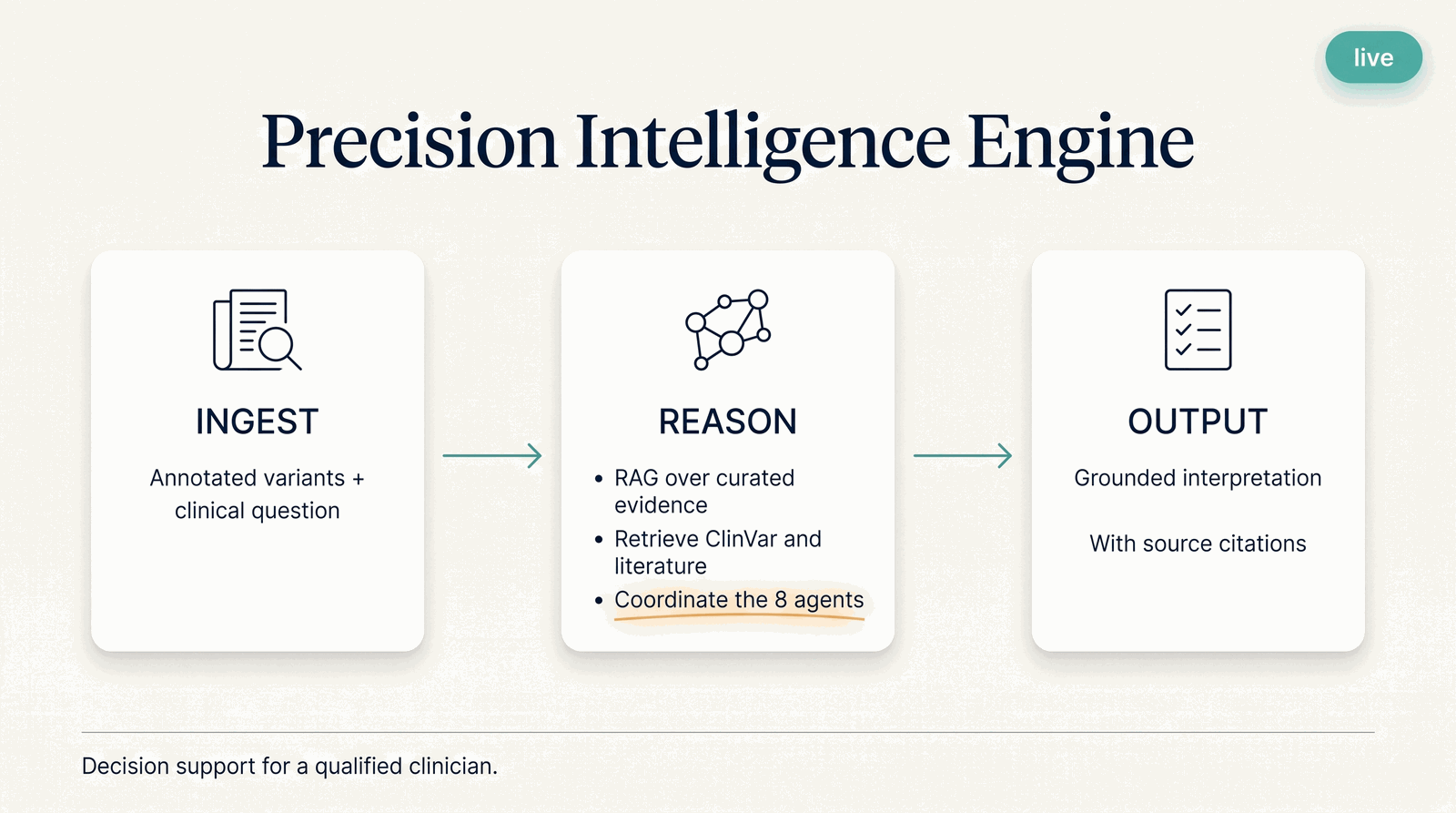
Illustrative. Decision support for a qualified clinician — never autonomous diagnosis or prescribing.
In plain terms
If the Genomics Foundations Engine finds where a patient's variants are, the Precision Intelligence Engine explains what they mean. It is the factory's interpretation brain. It takes a raw variant file — millions of rows — and turns it into a short, cited, plain-language narrative a clinician can actually use: which variants matter, why, and which point to a druggable target. That interpretation is the shared substrate the eight intelligence agents reason over.
Why it matters
A variant list is not an answer. The clinically meaningful signal is usually a handful of variants buried in millions, and the value is in the context — is this variant known to be pathogenic, what does it do to the protein, is there a therapy that targets it. This engine is what turns data into decision support: grounded, sourced, and honest about uncertainty, never an autonomous diagnosis.
For a patient: the difference between a raw list of millions of variants and a short, plain-language explanation of the few that actually affect their care.
How it works
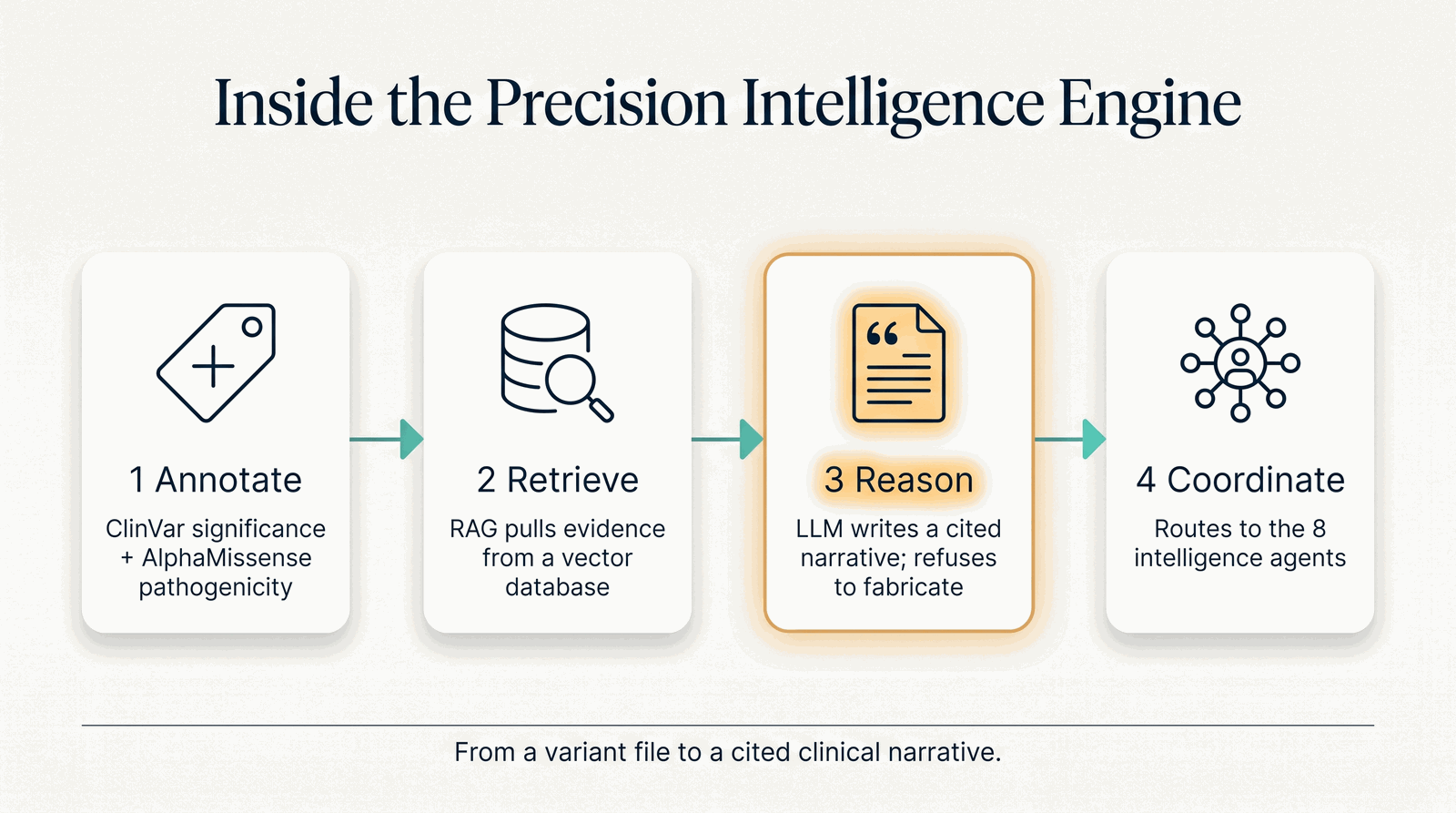
From a variant file to a cited clinical narrative — grounded in retrieved evidence. Illustrative.
- Annotate — each variant is tagged against curated knowledge: ClinVar clinical significance and AlphaMissense pathogenicity predictions.
- Retrieve — retrieval-augmented generation (RAG) pulls the relevant evidence from a vector database, so the narrative is built on real sources rather than a model's memory.
- Reason — a language model writes a grounded interpretation with citations, surfaces druggable targets, and is built to refuse rather than fabricate when evidence is thin.
- Hand off — the interpreted result is what the eight specialist agents (pharmacogenomics, oncology, rare disease, and the rest) reason over. Chaining engines and agents into one governed run is the workflow composer's job, not this engine's.
What goes in, what comes out
- In: a VCF of variants (from Engine 1) and a clinical query.
- Out: a cited clinical narrative — the interpreted, contextualized report.
Where it fits
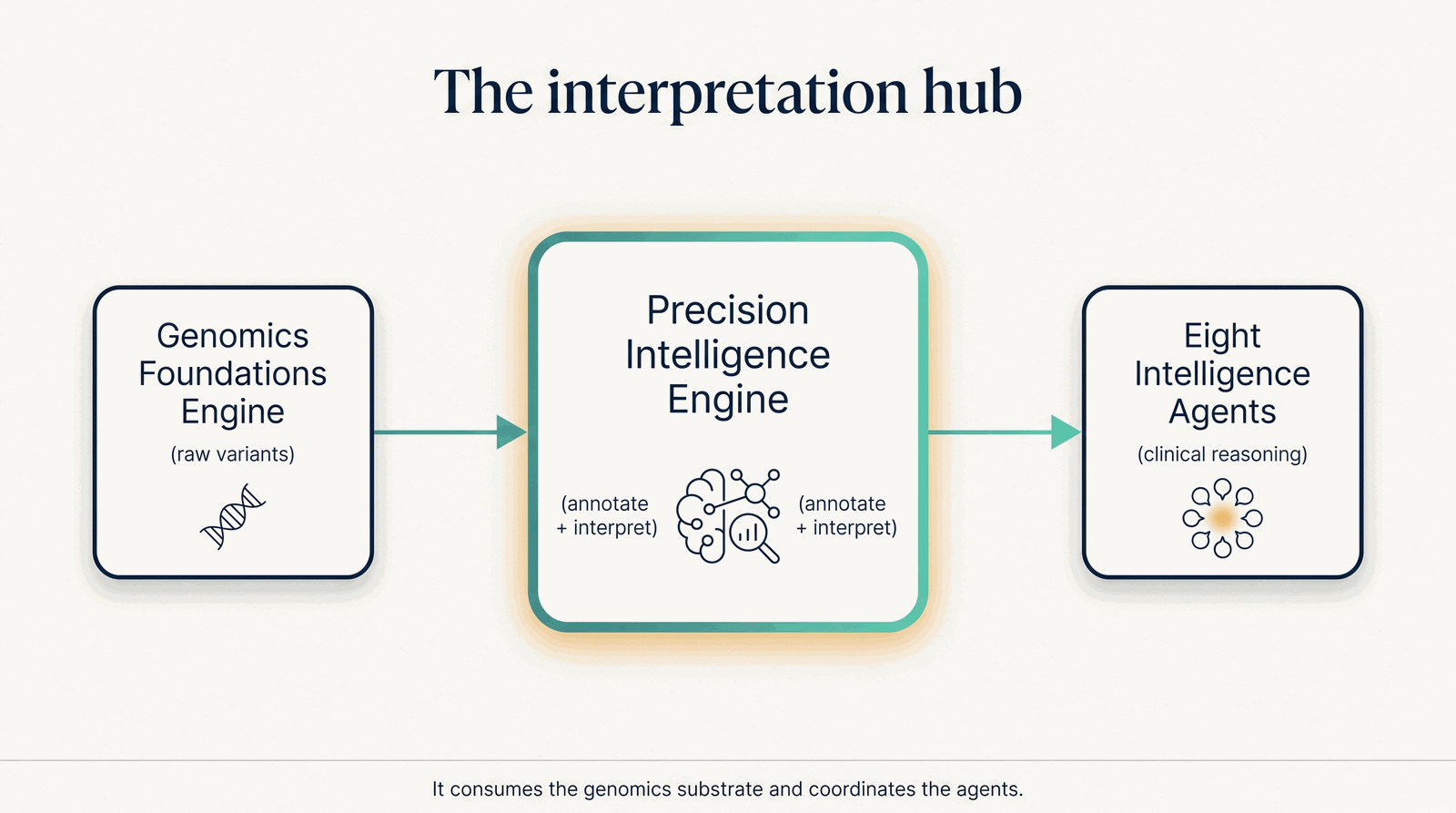
The interpretation layer: it consumes the genomics substrate and produces what the eight agents reason over. Illustrative.
It sits directly downstream of genomics and upstream of the agents — the interpretation layer the rest of the clinical reasoning depends on.
Honest limits
- Decision support, not diagnosis. Every output supports a qualified clinician; it never diagnoses or prescribes on its own.
- Grounded, and it says when it can't be. The interpretation is retrieval-grounded and cited; when its vector database or model key are absent it returns an honest degraded response, never invented clinical content.
- VEP is optional and manual. An Ensembl VEP container ships as an optional, manually-run annotator — it is not in the automated interpretation path.
Interface
- Endpoint:
localhost:5001· Invoke path:/ - Serving: native · GPU: no · Cost class: medium
Inputs
| Name | Shape | Semantic | Notes |
|---|---|---|---|
vcf |
file | vcf_variants | |
query |
scalar | — |
Outputs
| Name | Shape | Semantic | Notes |
|---|---|---|---|
report |
map | clinical_narrative | targets + clinical context |
Tags: rag · annotation · interpretation
↩ Back to the Engines index · the Capability Maturity Matrix · the Capability Brief.
Note
Status and interface are generated from the capability registry (lib/hcls_common/capabilities.json) — the site cannot claim ahead of the code. All clinical output is decision support for a qualified clinician, never autonomous diagnosis.