Rare Disease Intelligence Agent
live Domain: clinical Type: agent
RAG decision support for the diagnostic odyssey: 21 workflows (phenotype-driven search, variant interpretation, differential diagnosis, gene-therapy eligibility, newborn screening, metabolic workup, carrier and prenatal screening, natural history, therapy selection, trial matching, genetic counseling) across 14 disease categories, combining HPO phenotype matching, ACMG classification and trio analysis into a ranked shortlist of candidate diagnoses. A shortlist for a qualified clinician - never a diagnosis.
A narrated, captioned explainer. Decision support for a qualified clinician.
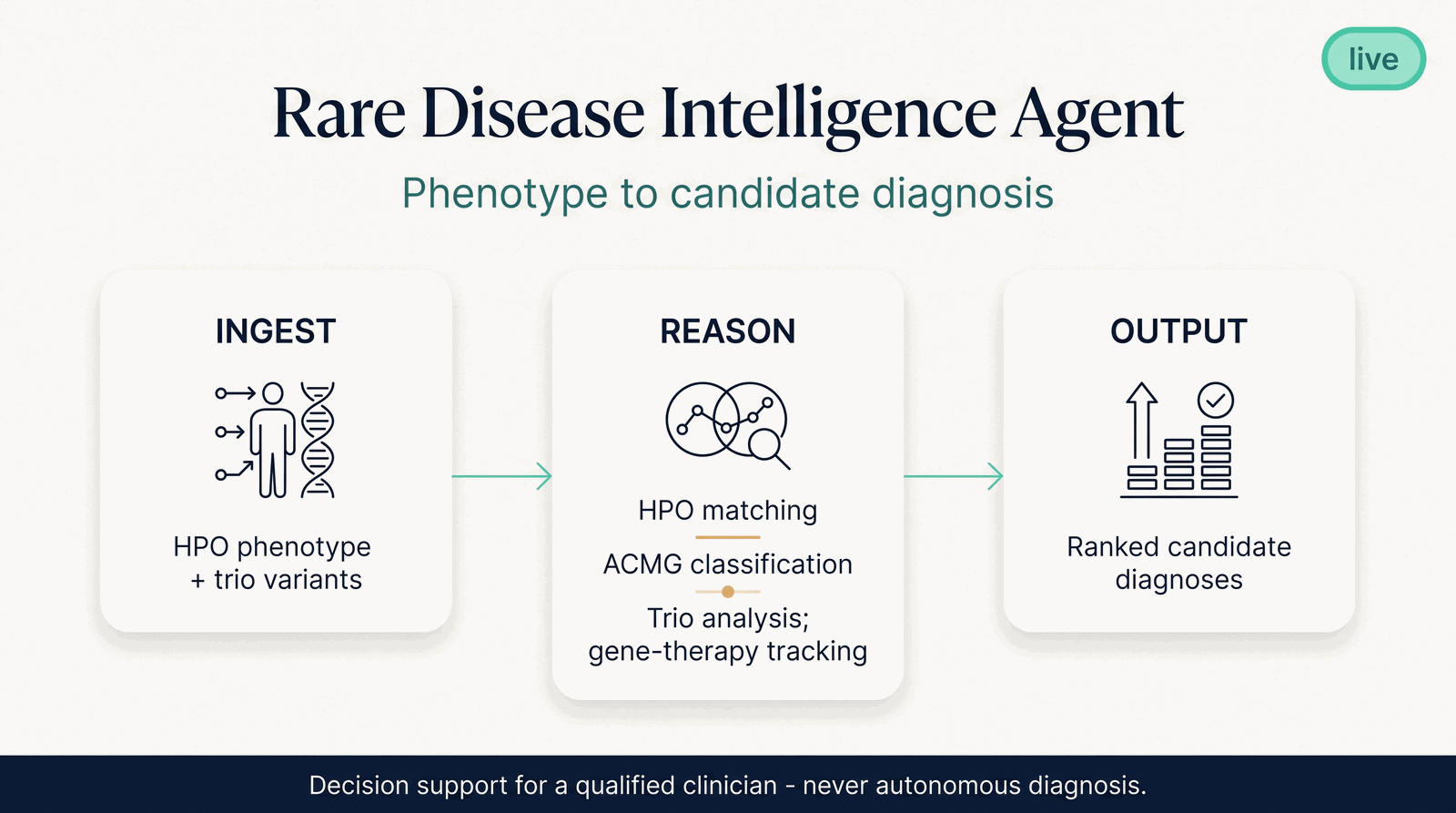
Illustrative. Decision support for a qualified clinician — never autonomous diagnosis or prescribing.
In plain terms
The Rare Disease Intelligence Agent helps narrow a diagnostic odyssey — the years-long search many rare-disease families endure. It reasons from a patient's phenotype (their observed symptoms and features, coded in a standard medical vocabulary called HPO, the Human Phenotype Ontology) and their family's genetics toward a ranked shortlist of candidate diagnoses. It classifies each variant by the ACMG criteria — the standard rules geneticists use to call a change harmful or harmless — and does it all as grounded, cited decision support.
Why it matters
Rare-disease patients often wait years for a diagnosis, cycling through specialists. Systematically matching phenotype to gene, classifying variants rigorously, and using trio (parent-child) data to resolve inheritance is exactly the kind of patient, evidence-heavy reasoning an intelligence layer can accelerate.
For a family: a years-long diagnostic search narrowed to a focused, explainable shortlist of candidates.
How it works
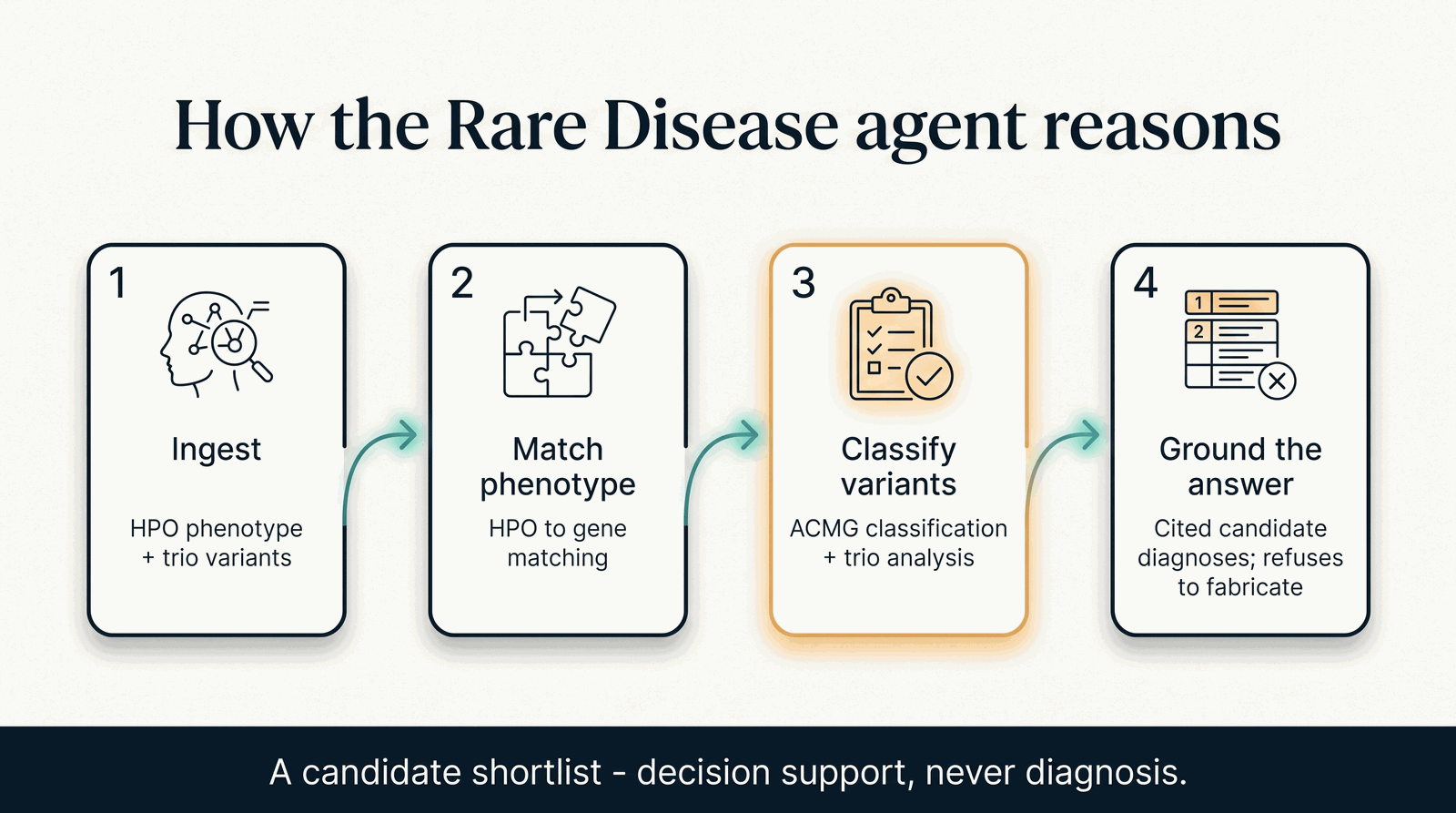
Phenotype and trio variants to ACMG-classified candidate diagnoses. Decision support. Illustrative.
- Ingest — the HPO phenotype and trio (parent-child) variants.
- Match phenotype — HPO-to-gene matching against curated knowledge.
- Classify variants — ACMG classification, with trio analysis to resolve inheritance.
- Ground the answer — a ranked candidate-diagnosis shortlist (with gene-therapy tracking) that refuses to fabricate where evidence is thin.
What goes in, what comes out
- In: a query and the patient context (HPO phenotype, trio variants).
- Out: a grounded, cited set of ranked candidate diagnoses.
Where it fits
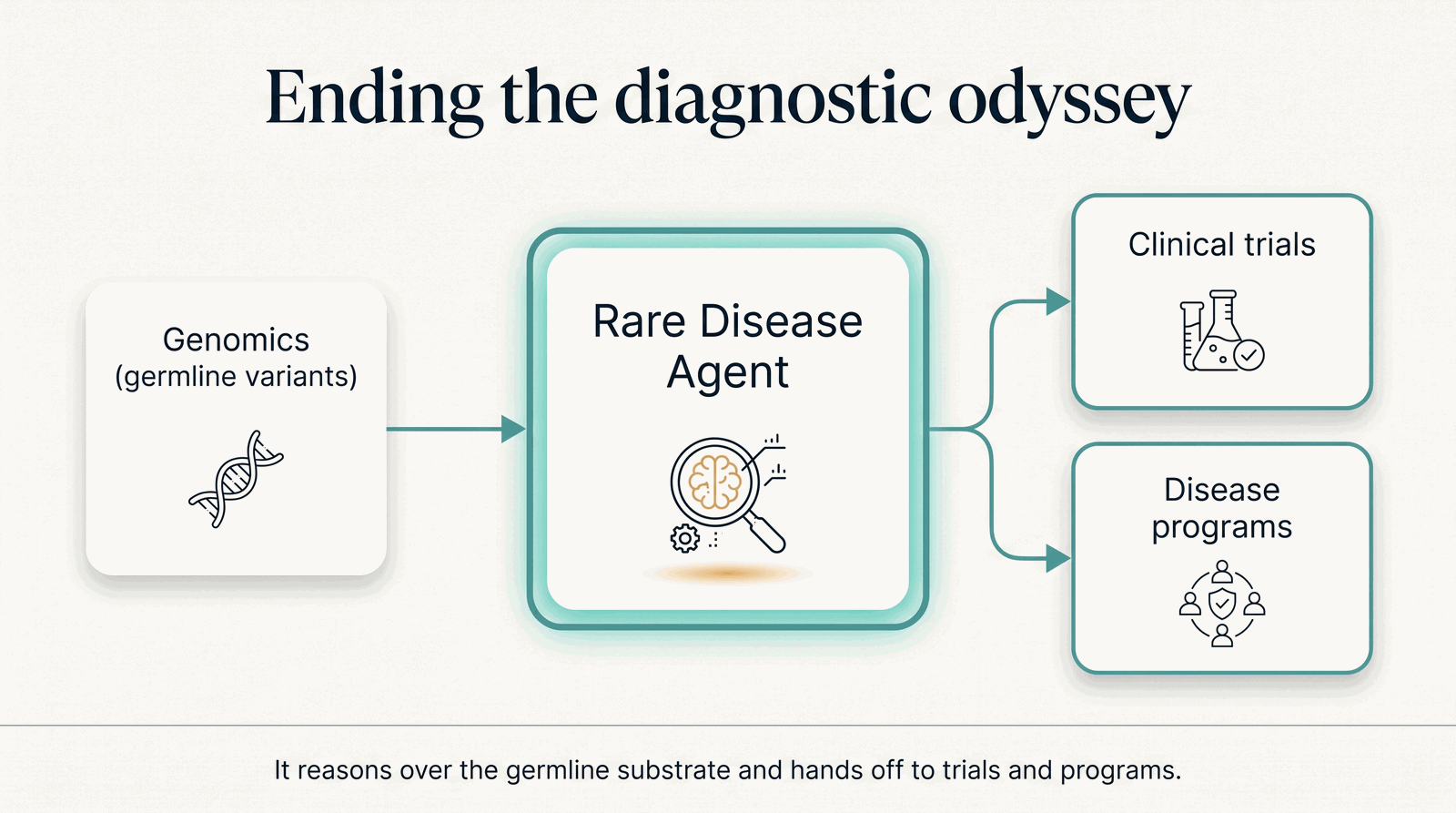
It reasons over the germline genomics substrate and hands off to trials and disease programs. Illustrative.
It reasons over the germline variants from the Genomics Foundations Engine, hands off to the Clinical Trial agent, and feeds the disease programs (such as Tuberous Sclerosis).
Honest limits
- Decision support, never diagnosis. It produces a candidate shortlist for a qualified clinician; it does not diagnose.
- Grounded, and honest when it can't be. As a retrieval-augmented service it needs a populated vector database and an LLM API key at runtime, returning an honest degraded response (HTTP 503) rather than inventing content when they're absent.
- Gene therapy is preclinical. Where gene-therapy tracking points to a correction, that remains preclinical research, not a treatment available today.
Interface
- Endpoint:
localhost:8544· Invoke path:/ - Serving: native · GPU: no · Cost class: —
Inputs
| Name | Shape | Semantic | Notes |
|---|---|---|---|
question |
scalar | — | Field name is question — verified against the live route, which rejects query with 422. |
patient_context |
map | patient_context |
Outputs
| Name | Shape | Semantic | Notes |
|---|---|---|---|
answer |
map | clinical_narrative |
Tags: agent · rare-disease
Runtime dependency
This agent is a Retrieval-Augmented Generation service: at runtime it needs a populated vector database and an LLM API key. When those are absent it returns an honest degraded response (e.g. HTTP 503) and never fabricates clinical content.
↩ Back to the Intelligence Agents index · the Capability Maturity Matrix · the Capability Brief.
Note
Status and interface are generated from the capability registry (lib/hcls_common/capabilities.json) — the site cannot claim ahead of the code. All clinical output is decision support for a qualified clinician, never autonomous diagnosis.