Chai Discovery
Chai Discovery builds two frontier models the factory is designed around — one to predict molecular complexes, one to design new binders. They chain: Chai-2 designs a binder, Chai-1 validates the binder–target complex. Both are Frontier Models, connected on demand via elastic burst.
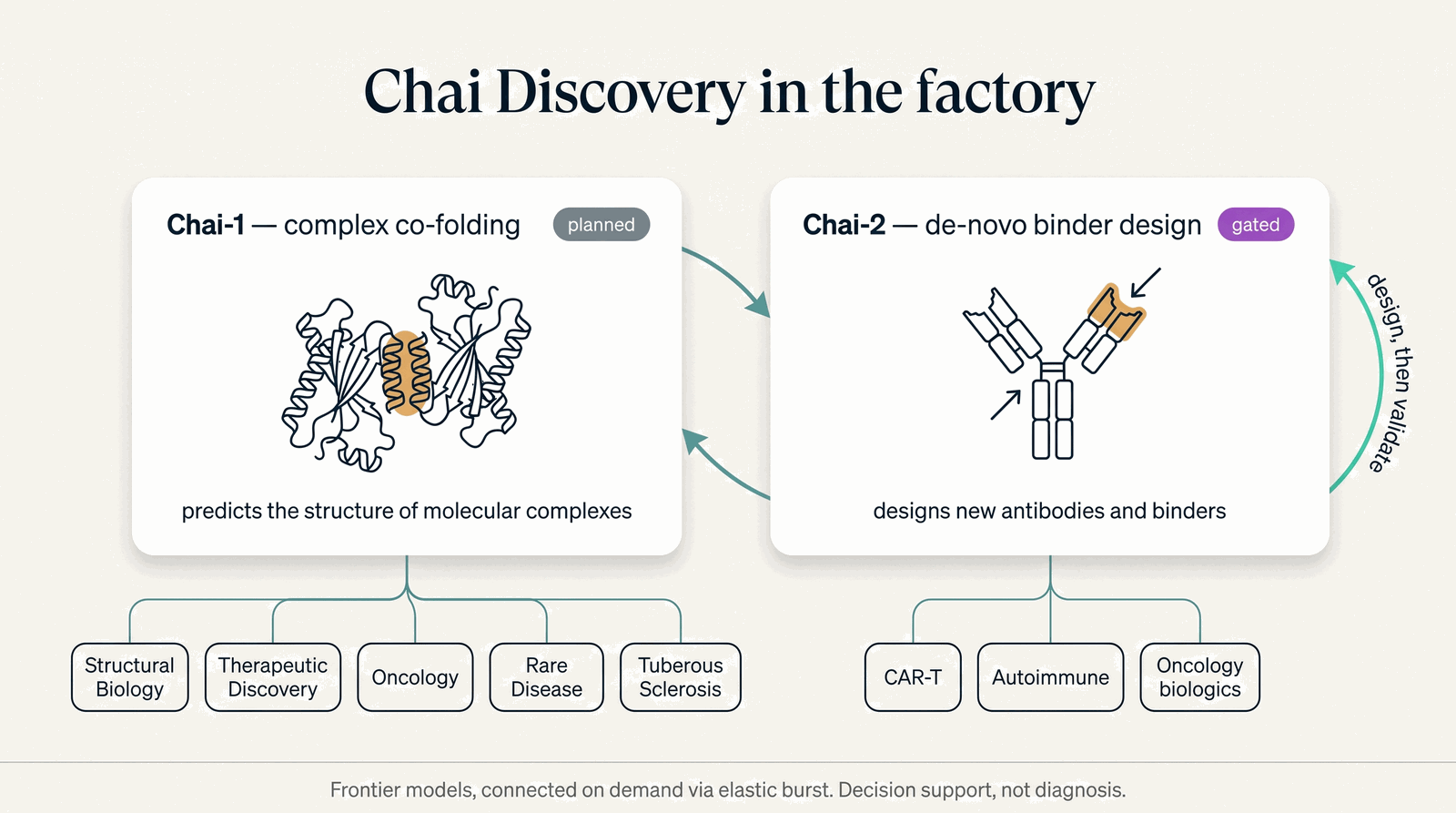
Illustrative. Chai-1 is planned (open, Apache-2.0); Chai-2 is gated (partner access). Both burst to a remote GPU.
Chai-1 — complex co-folding planned
Open (Apache-2.0, commercial-cleared); build in progress — flips to live when it is stood up.
AlphaFold3-class structure prediction of complexes — proteins with other proteins, small-molecule ligands, and DNA/RNA — the co-folding that ESMFold (single-sequence only) cannot do. Where it plugs in:
| Capability | What Chai-1 adds |
|---|---|
| Structural Biology Engine | Complex co-folding; anchors the design-then-validate chain (RFdiffusion → ProteinMPNN → Chai-1). |
| Therapeutic Discovery Engine | Structure-based design — co-fold a candidate molecule inside its target's pocket to confirm it binds. |
| Precision Oncology Engine | Fusion-protein, drug–target, and neoantigen–MHC complex structures for the tumor board. |
| CAR-T · Precision Autoimmune agents | scFv–antigen and antibody–antigen / HLA–peptide complexes — the structural basis of recognition. |
| Rare Disease · Neurology agents | Whether a missense variant disrupts a protein interface — mechanistic evidence for pathogenicity. |
| Tuberous Sclerosis (flagship) | Co-fold the hamartin–tuberin (TSC1–TSC2) complex and show how a pathogenic variant breaks it — making the gene → mTORC1 → everolimus story structurally concrete. |
Chai-2 — de-novo binder & antibody design gated
Partner access via Chai's platform (not open weights); integration contingent on access.
Zero-shot design of new antibodies and protein binders against a target. Its home is the binder-design family:
| Capability | What Chai-2 adds |
|---|---|
| CAR-T Intelligence Agent | Design novel scFv / binding domains for CAR-T targets. |
| Precision Autoimmune Agent | Design autoantibody-neutralizing or de-immunized binders. |
| Precision Oncology · Therapeutic Discovery | Biologics against tumor antigens — large-molecule design alongside small-molecule discovery. |
| Structural Biology Engine | The design frontier; hand off to Chai-1 to validate the designed complex. |
Working with NVIDIA BioNeMo
Chai and NVIDIA BioNeMo are complementary halves of one design bench: Chai predicts and designs structures; BioNeMo generates and docks the small molecules that populate them. Together they cover a target from both directions.
A ~90-second walkthrough: Chai-1 predicts a complex, BioNeMo fills the pocket with docked small molecules, Chai-1 validates the pose, and Chai-2 adds a biologic lane. Roadmap where noted — decision support, not diagnosis.
- Chai-1 validates BioNeMo's small molecules. BioNeMo's MolMIM generates candidate compounds and DiffDock docks them; Chai-1 then co-folds the top candidate inside the target pocket — a structure-based cross-check on the docking pose. A different method reaching the same answer raises confidence in the lead.
- Chai-2 adds the large-molecule lane. Alongside BioNeMo's small-molecule discovery, Chai-2 designs de-novo biologics, and Chai-1 validates either — so a single target can be pursued as a small molecule (BioNeMo) or an antibody / protein binder (Chai) in parallel.
What the pairing enables:
| Engine / Agent | What Chai + BioNeMo unlock together |
|---|---|
| Therapeutic Discovery Engine | Both design lanes — BioNeMo small-molecule, Chai-2 large-molecule — with Chai-1 as the shared structural validator. |
| Structural Biology Engine | Chai-1 co-folds BioNeMo's docked ligands into a full predicted complex — pose meets structure. |
| Precision Oncology Engine | Offer a tumor board both a small-molecule inhibitor (BioNeMo) and a biologic (Chai-2) against one target, each with structural evidence. |
(Honesty: the BioNeMo half — MolMIM, DiffDock — is live but needs the NIM container deployed; Chai-1
is planned and Chai-2 is gated, so the integrated loop is a roadmap capability. All of it is
preclinical decision support, bursting to a remote GPU.)
Honest by construction
Chai-1 is planned (open, build in progress) and Chai-2 is gated (partner access) — see the live
Capability Maturity Matrix. Both burst to a remote GPU, never
pretending to run on the box; and any clinical use is decision support for a qualified
clinician, never autonomous diagnosis.