Neurology Intelligence Agent
live Domain: clinical Type: agent
RAG decision support across 10 neurology domains (cerebrovascular, neurodegenerative, epilepsy, MS, neuro-oncology, movement disorders, headache, neuromuscular, neurogenetics, neuroimmunology), with validated clinical scales, ATN biomarker staging for Alzheimer's, EDSS for MS, and research staging for Parkinson's. Staging frameworks (NSD-ISS / SynNeurGe, alpha-synuclein SAA, plasma p-tau217) are research-/trial-use inputs, not routine diagnostics. Decision support for a qualified clinician, never autonomous diagnosis.
A narrated, captioned explainer. Decision support for a qualified clinician.
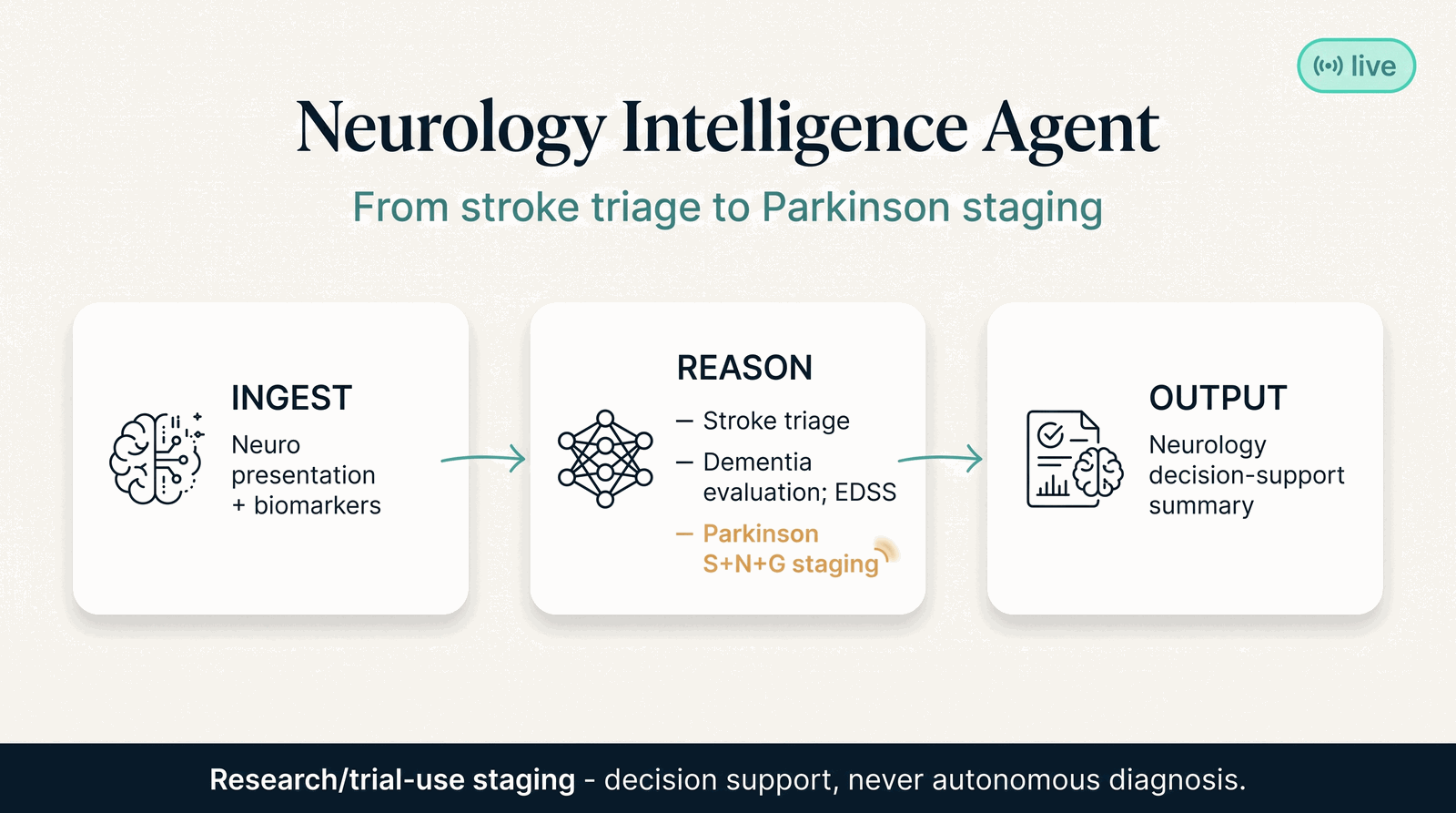
Illustrative. Decision support for a qualified clinician — never autonomous diagnosis or prescribing.
In plain terms
The Neurology Intelligence Agent is a broad neurology reasoning layer — decision support across ten domains, from stroke triage to dementia evaluation to multiple sclerosis, with Parkinson's featured. It grounds each answer in the literature and returns it, cited, for a clinician to weigh.
Why it matters
Neurology spans very different problems that share a need for careful, staged reasoning: a stroke needs minutes-fast triage, a neurodegenerative disease needs longitudinal staging. One grounded agent that can reason across those domains — and cite why — is a genuine aid to a busy service.
For a patient: one consistent, evidence-grounded read across very different neurological problems, from stroke to slow-moving disease.
How it works
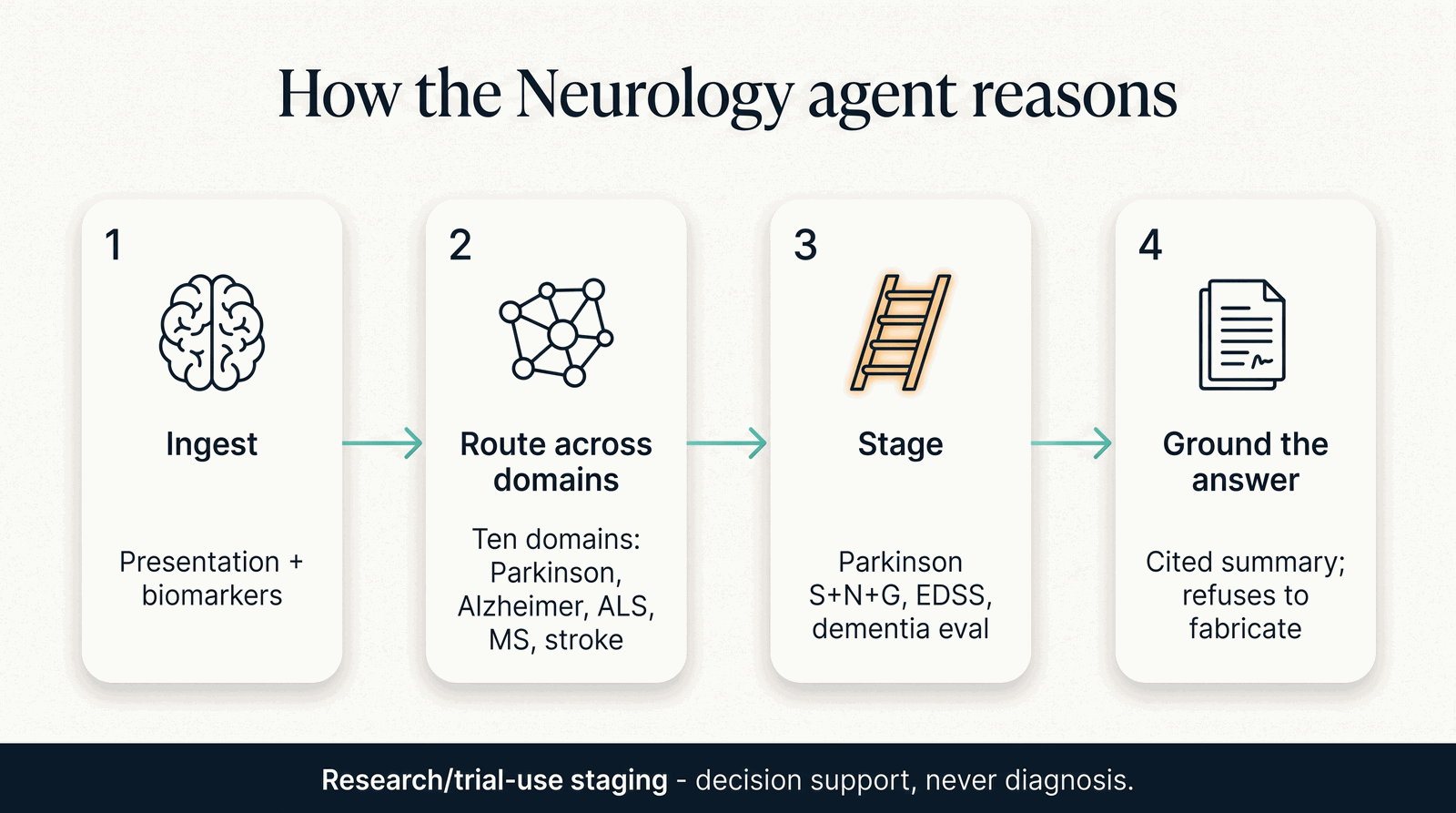
Ten neurology domains, with Parkinson's S+N+G staging. Research/trial-use frameworks, decision support. Illustrative.
- Ingest — the neurological presentation and any biomarkers, with patient context.
- Route across domains — reasoning across ten domains (Parkinson's, Alzheimer's, dementia, ALS, MS, stroke, and more).
- Stage — domain-specific staging such as Parkinson's S+N+G, EDSS for MS, and dementia evaluation.
- Ground the answer — a cited neurology summary that refuses to fabricate where evidence is thin.
What goes in, what comes out
- In: a query and the patient context (presentation, biomarkers).
- Out: a grounded, cited neurology summary.
Where it fits
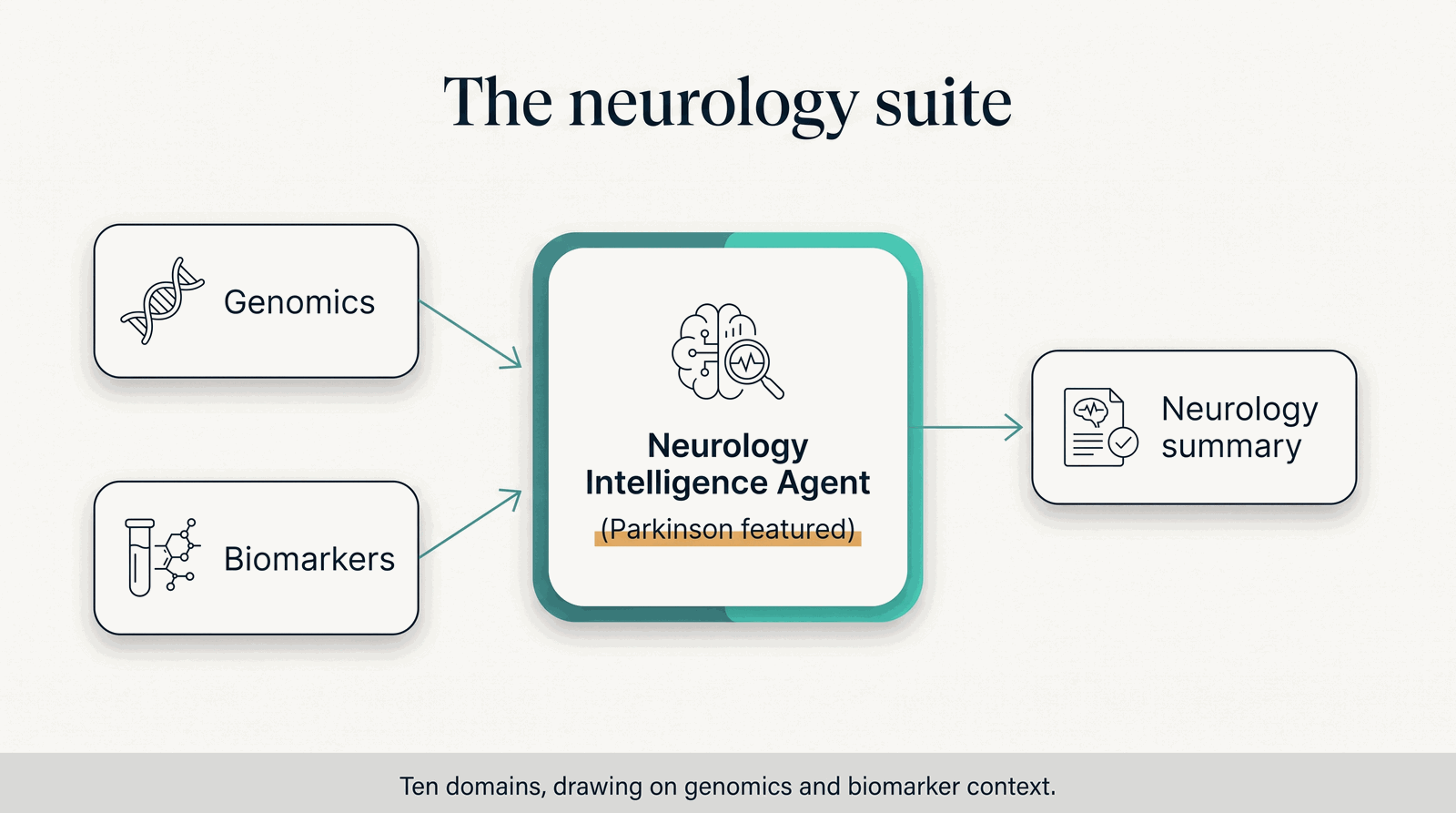
The neurology suite, Parkinson's featured; it draws on genomics and biomarker context. Illustrative.
It is the neurology suite of the factory — Parkinson's featured — drawing on genomics and biomarker context and anchoring the neurology demonstration.
Honest limits
- Research/trial-use staging. Frameworks such as Parkinson's S+N+G staging and related biomarker inputs are research- or trial-use, not routine clinical diagnostics.
- Decision support, never diagnosis. It supports a qualified clinician; it does not diagnose.
- Grounded, and honest when it can't be. As a retrieval-augmented service it needs a populated vector database and an LLM API key at runtime, returning an honest degraded response (HTTP 503) rather than inventing content when they're absent.
Interface
- Endpoint:
localhost:8535· Invoke path:/ - Serving: native · GPU: no · Cost class: —
Inputs
| Name | Shape | Semantic | Notes |
|---|---|---|---|
question |
scalar | — | Field name is question — verified against the live route, which rejects query with 422. |
patient_context |
map | patient_context |
Outputs
| Name | Shape | Semantic | Notes |
|---|---|---|---|
answer |
map | clinical_narrative |
Tags: agent · neurology
Runtime dependency
This agent is a Retrieval-Augmented Generation service: at runtime it needs a populated vector database and an LLM API key. When those are absent it returns an honest degraded response (e.g. HTTP 503) and never fabricates clinical content.
↩ Back to the Intelligence Agents index · the Capability Maturity Matrix · the Capability Brief.
Note
Status and interface are generated from the capability registry (lib/hcls_common/capabilities.json) — the site cannot claim ahead of the code. All clinical output is decision support for a qualified clinician, never autonomous diagnosis.