Therapeutic Discovery Engine
live Domain: small_molecules Type: engine
Target to ranked drug candidates: generation, docking, and RDKit scoring across a 10-stage pipeline. Generated leads are preclinical design candidates, not drugs. (Honesty: the 10-stage chemistry (RDKit QED/conformers/ranking) is real and live; molecule generation currently uses the real RDKit BRICS backend, the BioNeMo/MolMIM path is not deployed, and stage-7 docking requires the DiffDock NIM.)
A narrated, captioned explainer. Decision support for a qualified clinician.
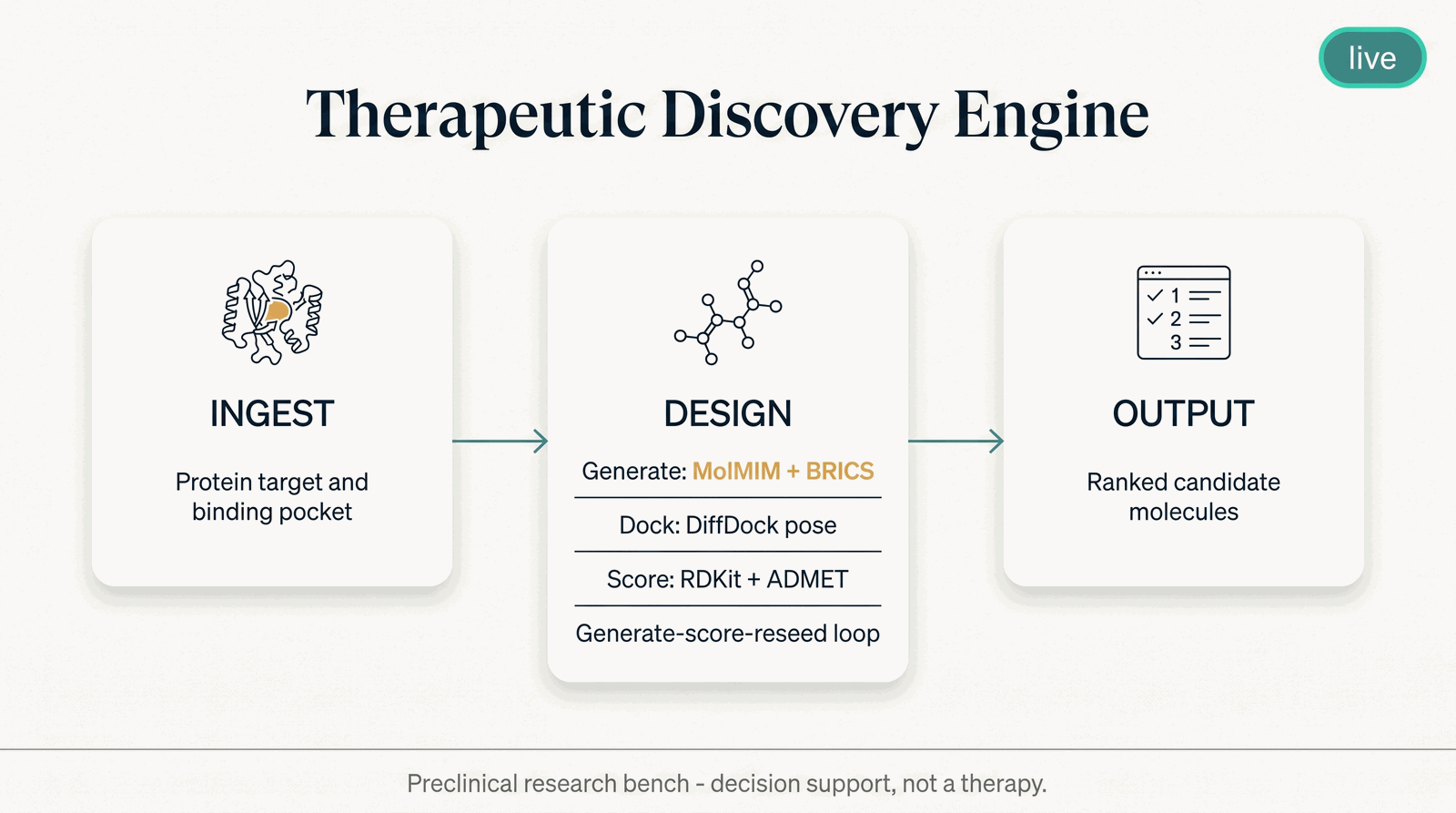
Illustrative. Decision support for a qualified clinician — never autonomous diagnosis or prescribing.
In plain terms
Give this engine a biological target, and it designs and ranks candidate small molecules that might act on it — a ten-stage generate → dock → score pipeline. Think of it as an automated, in-silico medicinal-chemistry bench: it proposes new molecules, predicts how they'd fit the target, and scores them for drug-likeness, then loops. The molecules it produces are preclinical design candidates — starting points for real lab work, not drugs.
Why it matters
The slowest, most expensive part of early drug discovery is going from "here is a druggable target" to "here are a few promising molecules worth making." Compressing that search computationally is how a single patient's target could, in principle, seed a therapeutic program in an afternoon instead of over months.
For a patient: a faster path from "here is the target driving your disease" to real candidate molecules worth testing.
How it works
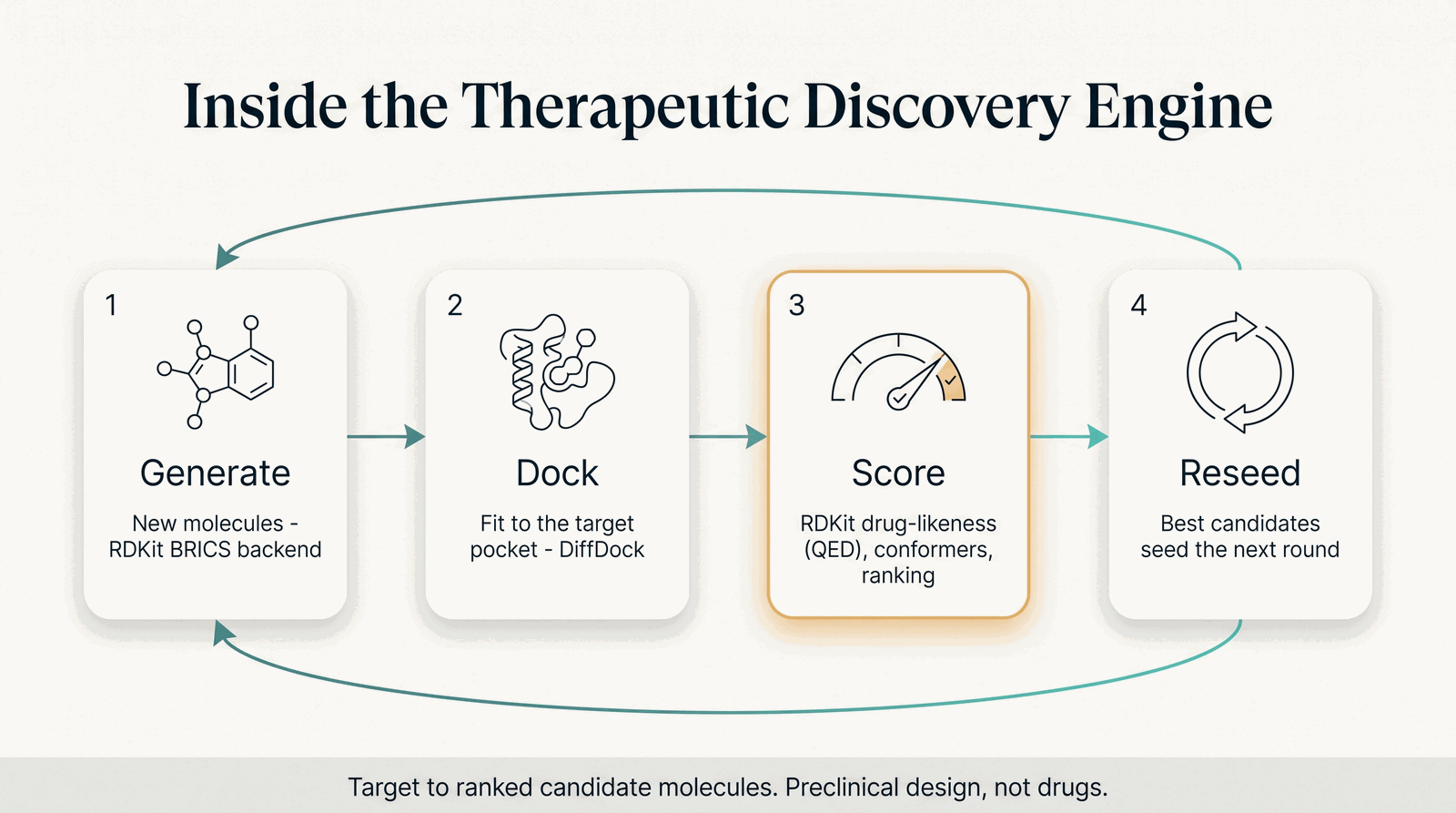
Target to ranked candidate molecules across a 10-stage pipeline. Preclinical design, not drugs. Illustrative.
- Generate (runs today) — new candidate molecules are produced with RDKit BRICS (a rules-based method that recombines drug-like fragments into new molecules) — the real, live generator today.
- Dock (optional add-on) — a molecule's fit into the target's binding pocket is predicted; this step uses the DiffDock model service, which must be running.
- Score (runs today) — RDKit computes drug-likeness (QED — a 0-to-1 "how drug-like is it?" score), generates 3-D shapes (conformers), and ranks candidates across the ten stages.
- Reseed — the best candidates feed a generate-score-reseed loop that iterates toward better molecules.
What goes in, what comes out
- In: a target.
- Out: ranked candidate molecules — preclinical design candidates to evaluate.
Where it fits
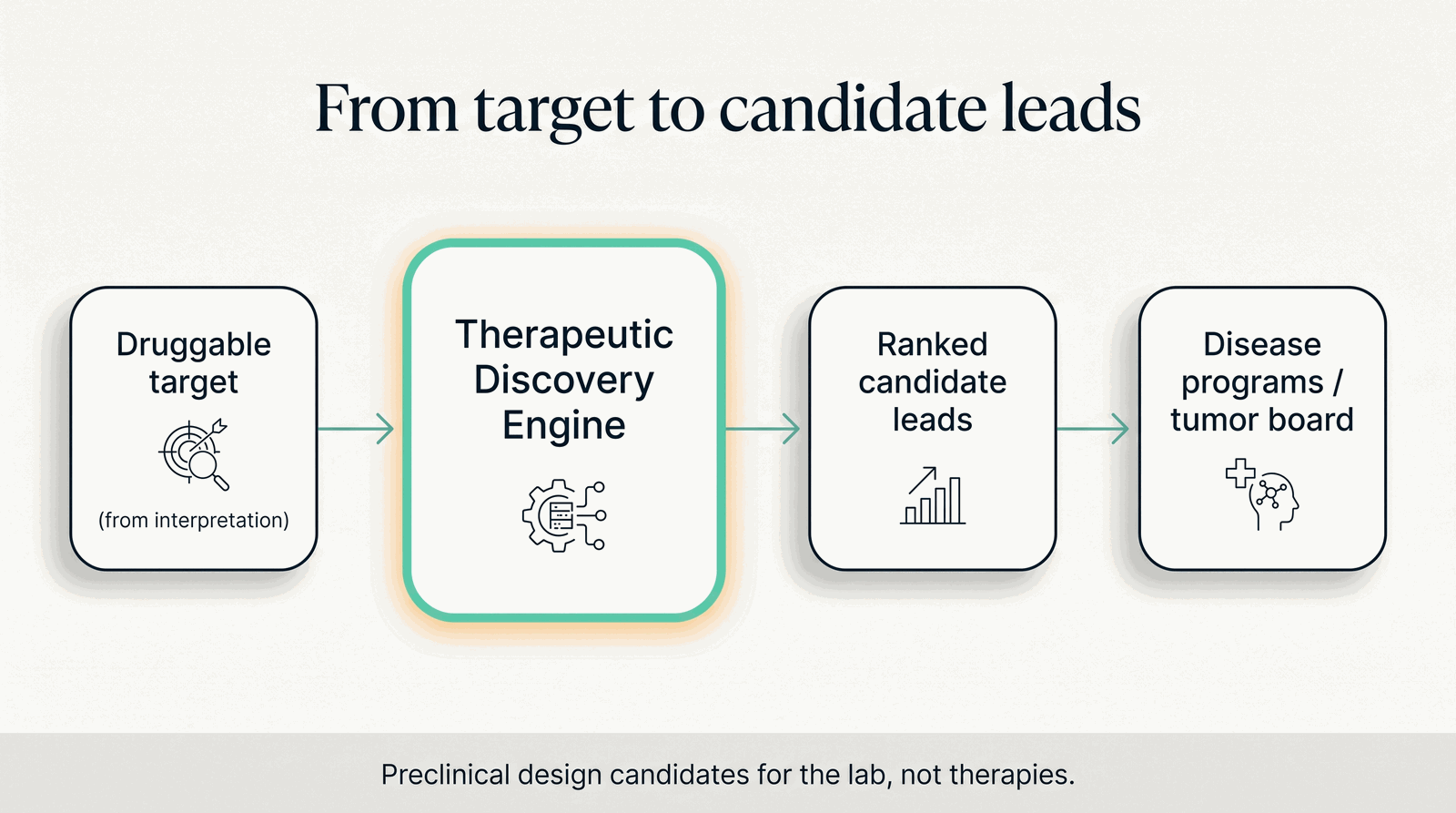
It consumes druggable targets surfaced upstream and feeds candidate leads to the disease programs. Illustrative.
Druggable targets identified by the Precision Intelligence Engine and the agents flow in; ranked candidate leads flow out toward the disease programs and molecular tumor boards.
Honest limits
- Preclinical design candidates, not drugs. Generated leads are hypotheses for the lab, nothing more.
- What's real today. The ten-stage chemistry (RDKit QED, conformers, ranking) is real and live, and generation uses the RDKit BRICS backend. The BioNeMo / MolMIM generation path is not deployed, and stage-7 docking requires the DiffDock model service.
- Frontier co-folding is separate. AlphaFold3-class complex co-folding (Chai-1) is a distinct,
plannedfrontier capability — not part of this pipeline yet.
Interface
- Endpoint:
localhost:8505· Invoke path:/ - Serving: container · GPU: yes · Cost class: high
Inputs
| Name | Shape | Semantic | Notes |
|---|---|---|---|
target |
map | — | gene/protein target spec |
Outputs
| Name | Shape | Semantic | Notes |
|---|---|---|---|
candidates |
list_of_objects | molecule_candidates | ranked molecules with scores |
Tags: molmim · diffdock · rdkit · stage3
↩ Back to the Engines index · the Capability Maturity Matrix · the Capability Brief.
Note
Status and interface are generated from the capability registry (lib/hcls_common/capabilities.json) — the site cannot claim ahead of the code. All clinical output is decision support for a qualified clinician, never autonomous diagnosis.