Single-Cell Intelligence Agent
live Domain: clinical Type: agent
Reasoning layer over the Single-Cell Engine (Engine 8). RAG clinical interpretation of the engine's computed cell-type clusters plus literature: cell-type annotation, TME profiling (hot/cold/excluded), drug-response, subclonal architecture, and ligand-receptor analysis. Distinct from the 'singlecell-compute' engine that produces the clusters it reasons over — the engine computes, the agent interprets. Not a duplicate. Decision support for a qualified clinician, never diagnosis; drug-response predictions are hypotheses to test.
A narrated, captioned explainer. Decision support for a qualified clinician.
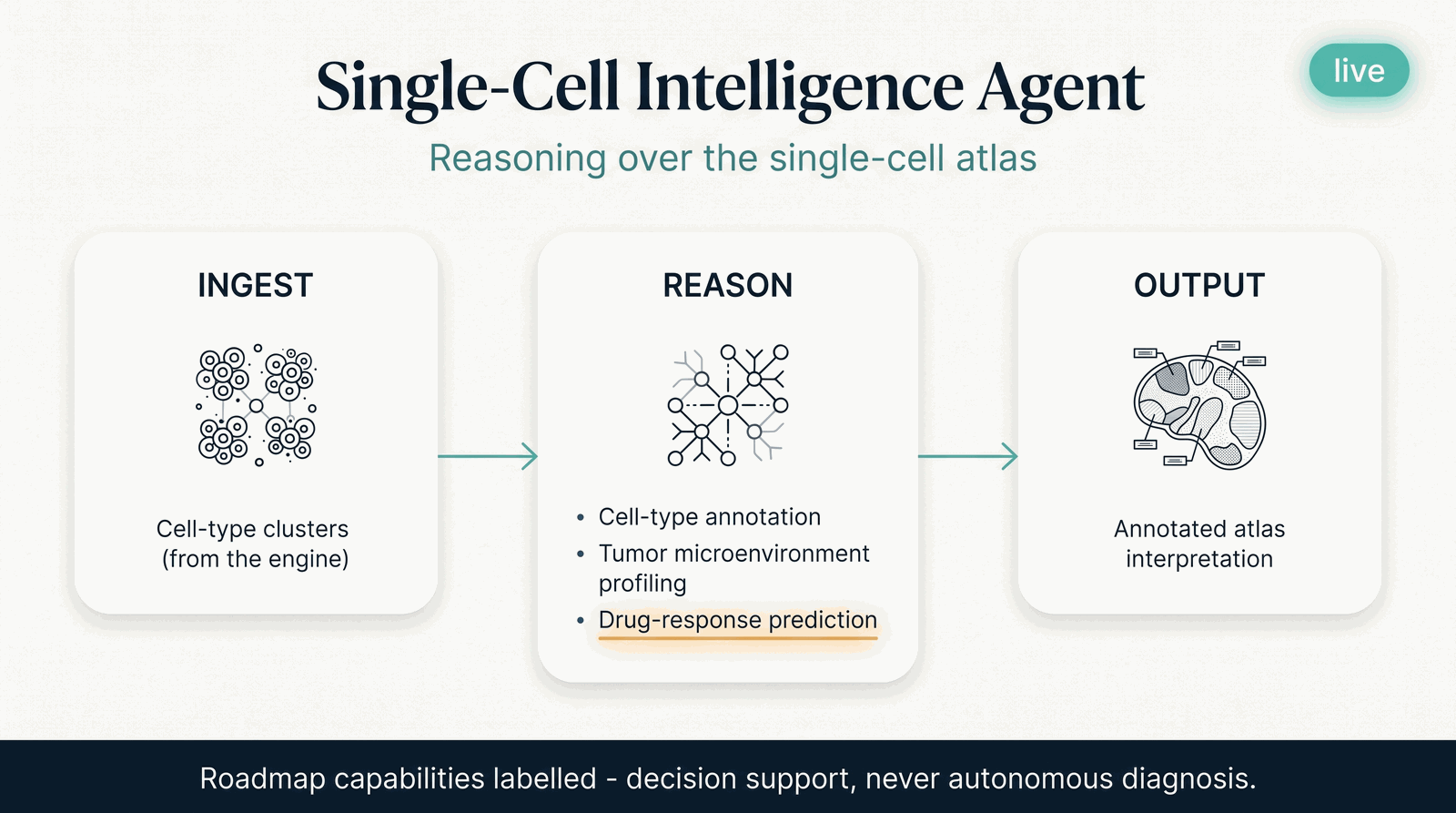
Illustrative. Decision support for a qualified clinician — never autonomous diagnosis or prescribing.
In plain terms
The Single-Cell Intelligence Agent is the reasoning layer over the Single-Cell Analysis Engine. The engine computes cell-type clusters; this agent interprets them — annotating cell types, profiling the tumor microenvironment, and reasoning about drug response — grounded in the literature. The engine computes; the agent interprets. They are two roles, not a duplicate.
Why it matters
A clustered single-cell dataset is a starting point, not an answer. The clinically interesting questions — what are these cells, is this tumor immunologically hot or cold, which subclone is driving it, what might it respond to — are interpretation problems. Separating the deterministic compute from the grounded reasoning is what keeps both honest.
For a patient: the cells driving their disease not just counted but interpreted — what they are, and what they might respond to.
How it works
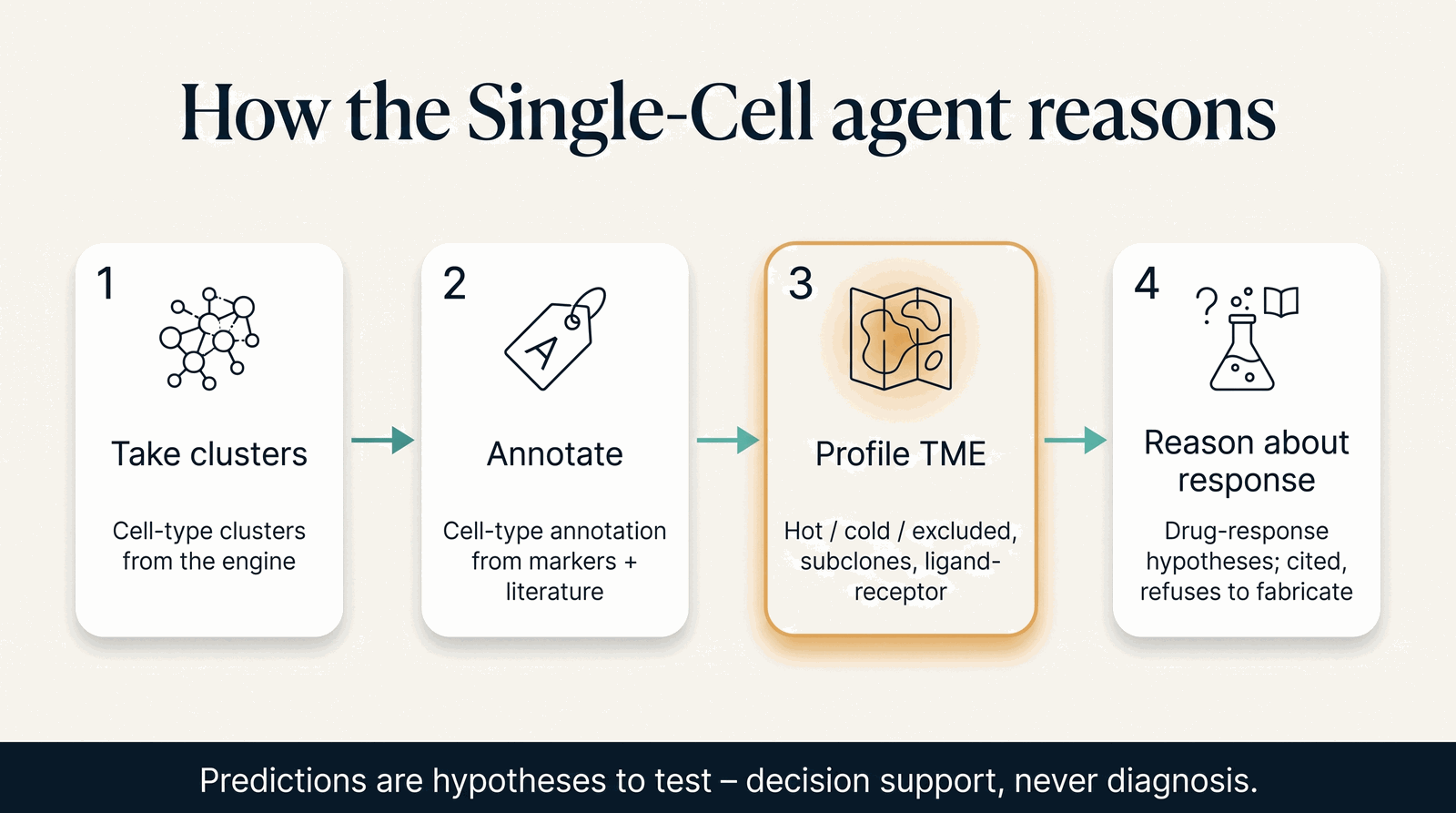
Interpreting the engine's clusters: annotation, TME profiling, drug-response hypotheses. Illustrative.
- Take the clusters — the cell-type clusters computed by the engine, plus patient context.
- Annotate — cell-type annotation grounded in markers and literature.
- Profile the TME — tumor-microenvironment profiling (hot / cold / excluded), subclonal architecture, and ligand-receptor analysis.
- Reason about response — drug-response reasoning, returned as a cited answer that refuses to fabricate — and whose predictions are hypotheses to test.
What goes in, what comes out
- In: a query and the patient context (the engine's computed clusters).
- Out: a grounded, cited single-cell interpretation.
Where it fits
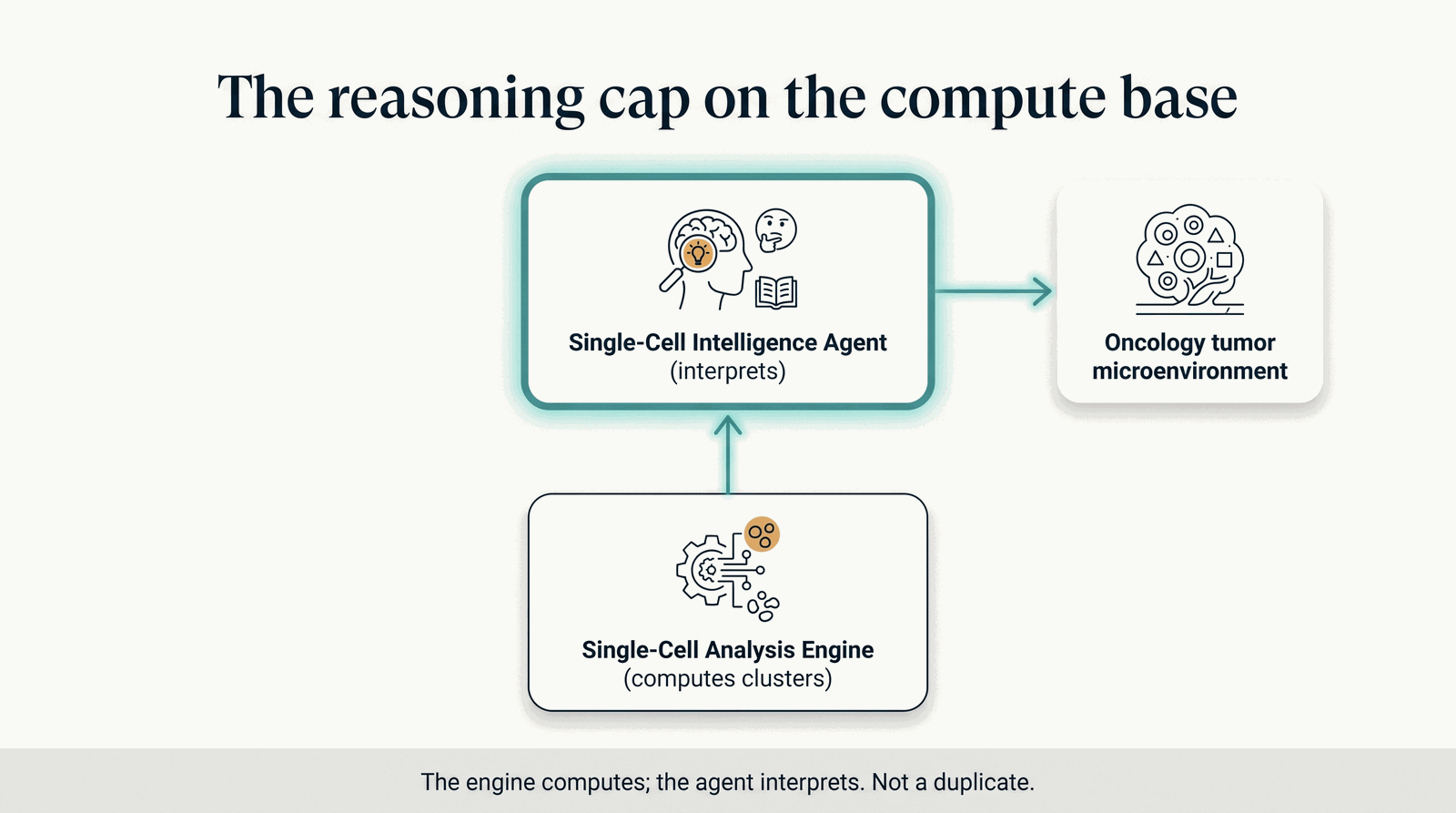
The reasoning cap on the compute base — the engine computes, the agent interprets. Illustrative.
It sits directly on top of the Single-Cell Analysis Engine — the engine produces the clusters, the agent reasons over them — and feeds oncology's tumor-microenvironment view.
Honest limits
- Not a duplicate of the engine. The engine computes clusters (verified on PBMC 3k); this agent interprets them. Two distinct roles.
- Drug-response predictions are hypotheses. They are leads to test, never treatment decisions.
- Decision support, never diagnosis. As a retrieval-augmented service it needs a populated vector database and an LLM API key at runtime, returning an honest degraded response (HTTP 503) rather than inventing content when they're absent.
Interface
- Endpoint:
localhost:8540· Invoke path:/ - Serving: native · GPU: no · Cost class: —
Inputs
| Name | Shape | Semantic | Notes |
|---|---|---|---|
question |
scalar | — | Field name is question — verified against the live route, which rejects query with 422. |
patient_context |
map | patient_context |
Outputs
| Name | Shape | Semantic | Notes |
|---|---|---|---|
answer |
map | tme_profile |
Tags: agent · single-cell
Runtime dependency
This agent is a Retrieval-Augmented Generation service: at runtime it needs a populated vector database and an LLM API key. When those are absent it returns an honest degraded response (e.g. HTTP 503) and never fabricates clinical content.
↩ Back to the Intelligence Agents index · the Capability Maturity Matrix · the Capability Brief.
Note
Status and interface are generated from the capability registry (lib/hcls_common/capabilities.json) — the site cannot claim ahead of the code. All clinical output is decision support for a qualified clinician, never autonomous diagnosis.