Clinical Trial Intelligence Agent
live Domain: clinical Type: agent
RAG decision support across 19 trial workflows spanning design and conduct: protocol design, patient matching, eligibility analysis and optimization, site selection, endpoint strategy, adaptive design, safety-signal monitoring, regulatory strategy, and competitive intelligence. Returns a cited, ranked trial shortlist with the criteria that matched. Eligibility is always confirmed with the trial itself; matches are informational. Decision support for the care team.
A narrated, captioned explainer. Decision support for a qualified clinician.
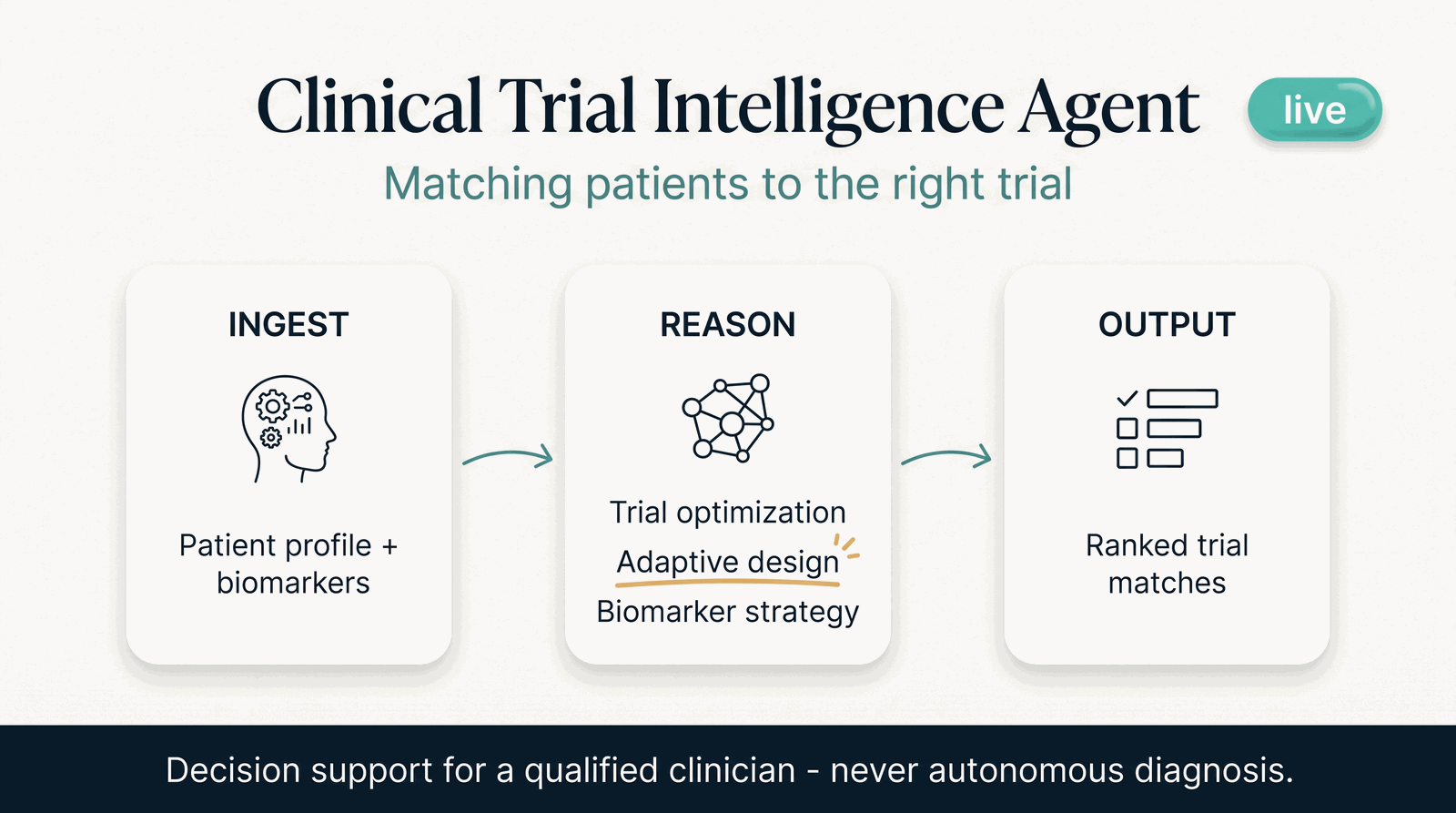
Illustrative. Decision support for a qualified clinician — never autonomous diagnosis or prescribing.
In plain terms
The Clinical Trial Intelligence Agent matches a patient to the right clinical trial — and helps design better trials. It reasons over a patient's profile and biomarkers to surface eligible trials, grounded and cited, as decision support for the care team.
Why it matters
The right trial can be the best available option, but eligibility criteria are dense and trials are scattered. For a rare-disease or pediatric-oncology patient especially, a grounded matching layer can turn a needle-in-a-haystack search into a short, explained shortlist.
For a patient: a hard-to-find but potentially best option — the right trial — surfaced as a short, explained shortlist.
How it works
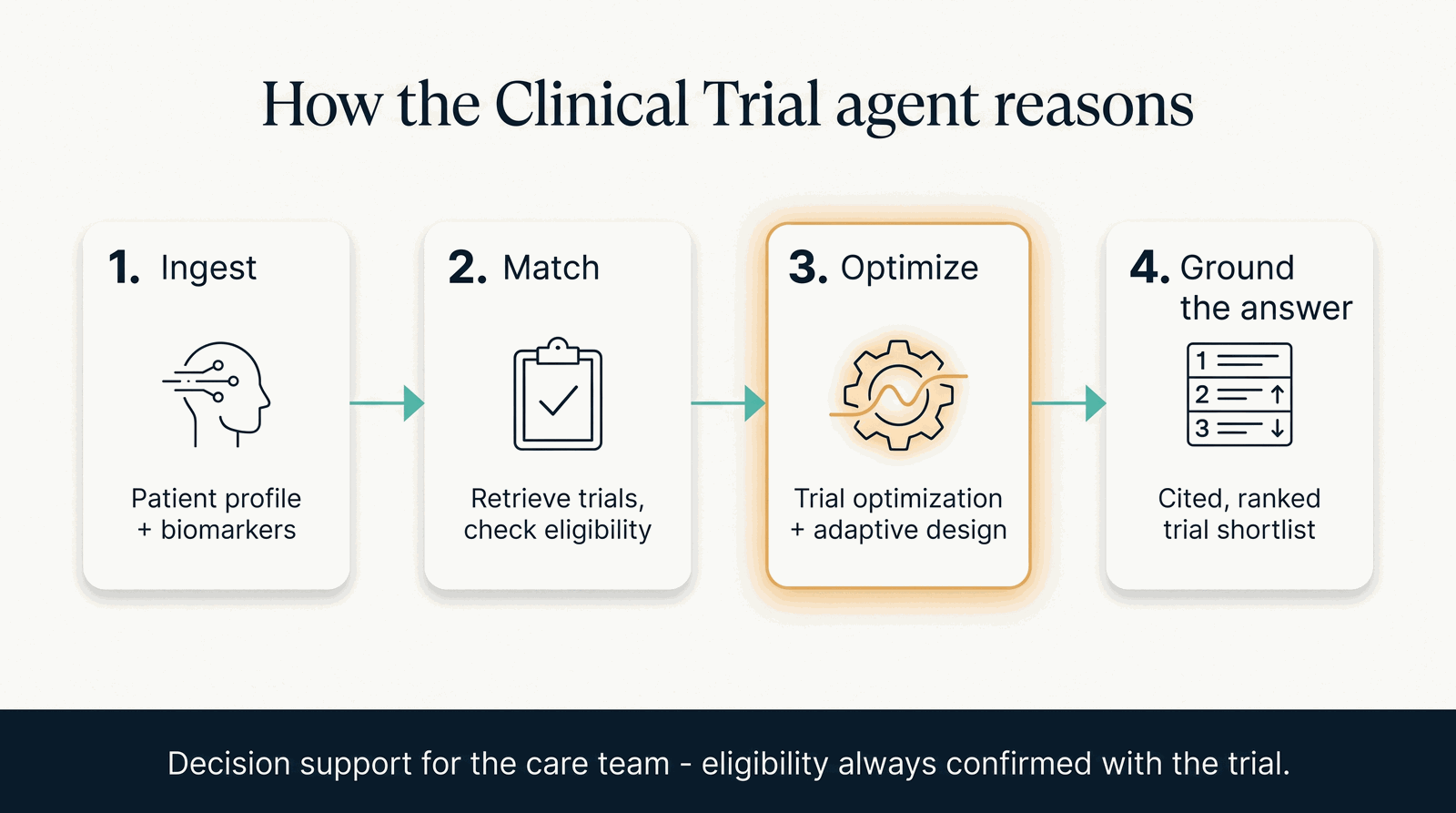
Patient profile and biomarkers to a ranked, cited trial shortlist. Decision support. Illustrative.
- Ingest — the patient profile and biomarkers.
- Match — candidate trials retrieved and checked against eligibility.
- Optimize — trial optimization, adaptive-design and biomarker-strategy reasoning.
- Ground the answer — a ranked, cited trial shortlist that refuses to fabricate where evidence is thin.
What goes in, what comes out
- In: a query and the patient context (profile, biomarkers).
- Out: a grounded, cited set of ranked trial matches for a patient — or, for researchers, trial-design and biomarker-strategy guidance.
Where it fits
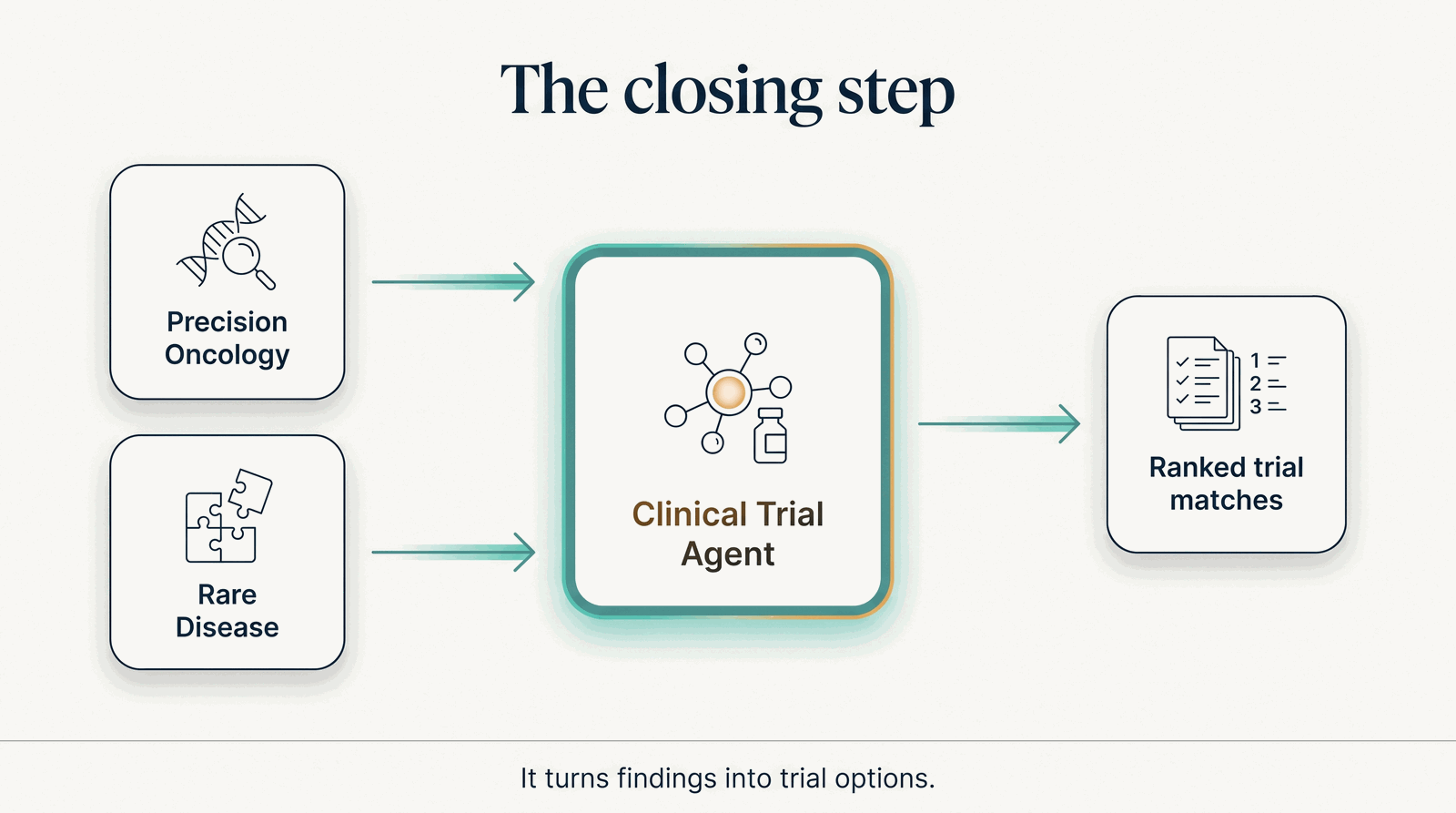
It takes a patient or a discovery and finds the trial; the closing step of many workflows. Illustrative.
It is often the closing step: the Precision Oncology Engine and Rare Disease agent hand off to it to turn findings into trial options.
Honest limits
- Decision support, never enrollment. It surfaces and explains options for the care team; it does not enroll or decide.
- Grounded, and honest when it can't be. As a retrieval-augmented service it needs a populated vector database and an LLM API key at runtime, returning an honest degraded response (HTTP 503) rather than inventing content when they're absent.
- Eligibility must be confirmed. Matches are a starting shortlist; formal eligibility is always confirmed with the trial.
Interface
- Endpoint:
localhost:8538· Invoke path:/ - Serving: native · GPU: no · Cost class: —
Inputs
| Name | Shape | Semantic | Notes |
|---|---|---|---|
question |
scalar | — | Field name is question — verified against the live route, which rejects query with 422. |
patient_context |
map | patient_context |
Outputs
| Name | Shape | Semantic | Notes |
|---|---|---|---|
answer |
map | trial_matches |
Tags: agent · trials
Runtime dependency
This agent is a Retrieval-Augmented Generation service: at runtime it needs a populated vector database and an LLM API key. When those are absent it returns an honest degraded response (e.g. HTTP 503) and never fabricates clinical content.
↩ Back to the Intelligence Agents index · the Capability Maturity Matrix · the Capability Brief.
Note
Status and interface are generated from the capability registry (lib/hcls_common/capabilities.json) — the site cannot claim ahead of the code. All clinical output is decision support for a qualified clinician, never autonomous diagnosis.