Governance & Lineage
Trust in a clinical-decision-support system is not a slogan — it's enforced at the boundaries of every capability. Governance in the HCLS AI Factory is mechanical: the registry is the source of truth, and every governed run passes through the same gates.
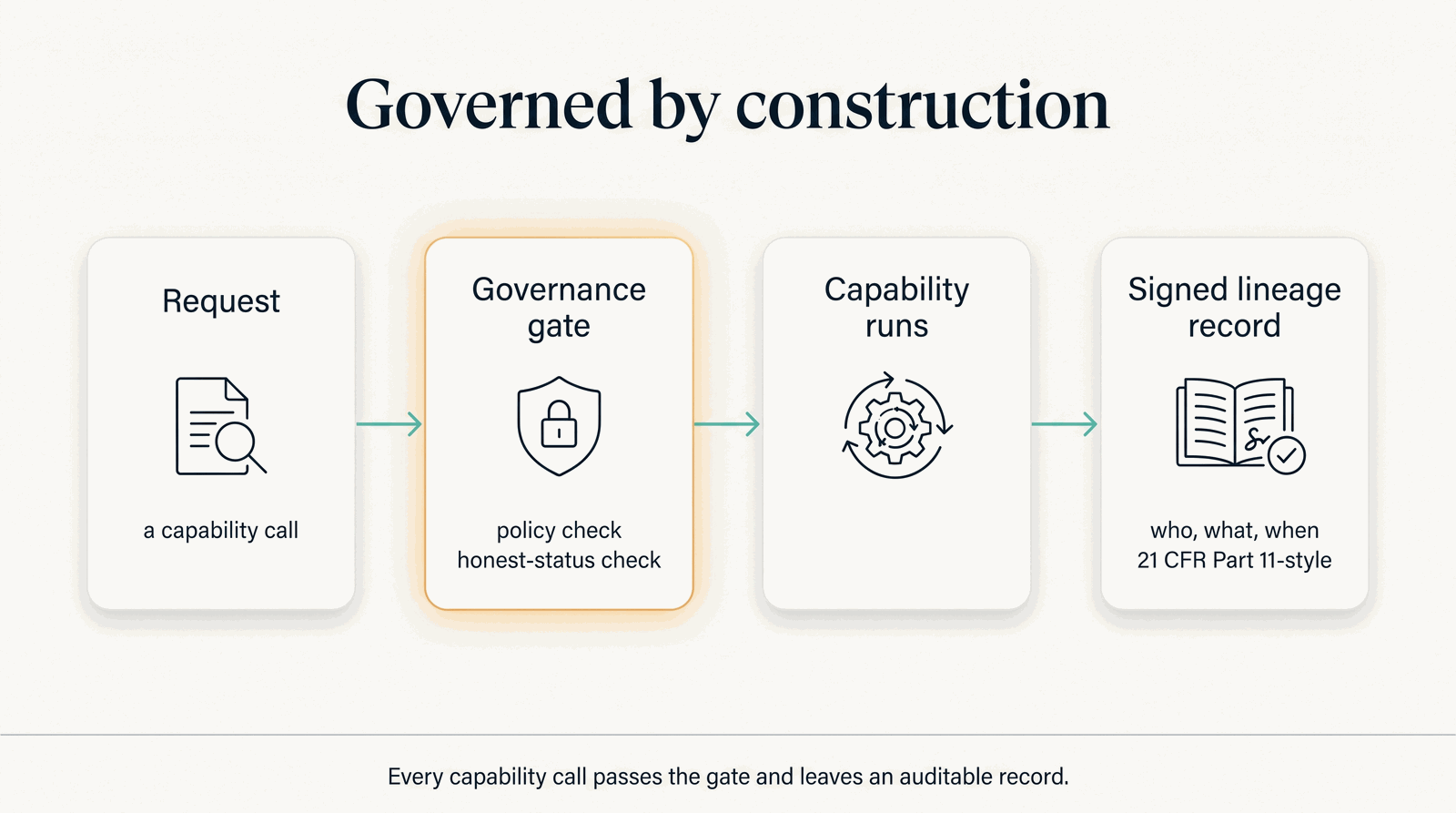
A governed run: request → gate → capability → lineage record. See Where the gates fire today below for current coverage.
The gates every governed run passes
- Input-validation gate — parameters are checked against each capability's typed contract (allowed values, numeric bounds, defaults) before anything runs. Bad input is rejected or clamped-and-logged, not silently mishandled.
- Output-honesty gate — a result is never presented as more confident than its weakest input or leg. Honesty is computed, not copied: a signal inherits the lowest maturity of what produced it.
- The registry honesty rules — a
livecapability can never be mock-served;verifiedcannot sit on anything that isn't actually running. Enforced in code (see the Capability Maturity Matrix).
Where the gates fire today
Honesty about the honesty layer: the gates are enforced on the governed path — capability calls made through the workflow composer and the tool surface — and adoption across the services' own HTTP routes is in progress.
| Coverage | |
|---|---|
| Governance middleware installed (request id, timing, service identity) | 11 of 12 services |
| Input-validation gate invoked by a handler | 1 of 12 |
| Output-honesty gate invoked by a handler | 1 of 12 |
| API-key authentication available (fail-closed once configured) | 12 of 12 |
The middleware is deliberately not a gate: it identifies and times a request. A handler must call
require_valid_input() and honesty_flags() for a call to be gated, and the response header
X-HCLS-Governed names only the gates that actually ran — it is absent when none did.
So a request to a service's own route is authenticated and identified, but not yet input-validated or honesty-checked unless that service has adopted the calls. We state the number rather than the intention.
Reproducible lineage (21 CFR Part 11-minded)
Governed runs carry a lineage manifest — inputs, the capability chain that produced each artifact, serving details, a composed honesty tier, and a deterministic lineage hash — so a result can be traced back to exactly what made it. The design intent is audit-grade reproducibility, not a black box.
Scope, stated plainly: the lineage mechanism (chain_lineage) is implemented and used on the
governed composer path. It is not yet emitted by the services' own HTTP routes. "21 CFR Part
11-minded" describes the design intent — traceable inputs, attributable steps, a deterministic
hash — and is not a claim of Part 11 validation or compliance.
The neutral, reproducible repository
- Neutral by construction — no proprietary vendor or alternate-edition branding in tracked files (a pre-commit guard enforces it). Data, weights, and secrets stay local; only code and docs publish.
- Reproducible build — pinned generators and a strict CI gate; this very site fails its build before publishing if the registry is malformed or a link breaks.
Privacy & the compute posture
All patient data stays on the local box. Heavy or ARM-incompatible models burst to remote GPU over a private mesh — "elastic burst," not "all on one box" — and only derived, non-identifying work is sent to a burst GPU, never raw PHI.
Decision support, not a medical device
The factory supports a qualified clinician; it does not diagnose or prescribe autonomously, and it is not marketed as a medical device. See Honesty & Governance and the Citations & Evidence behind every clinical claim.