Large-Molecule / Structural Biology Engine
planned Domain: proteins Type: engine
Large-molecule / structural-biology engine (E7): real protein structure prediction and design served on the GB10 — ESMFold folding, ESM-2 embeddings + Smith-Waterman search, ProteinMPNN sequence design, developability, and MHC immunogenicity. Aggregates the verified structural-biology models (ESMFold, ESM-2 search, ProteinMPNN) behind one engine; heavier/ARM-incompatible frontier co-folding (Chai-1) bursts to a remote GPU. Research-use / decision support, not a therapy. NOTE (2026-08-15): no process binds :8581 -- this engine is five separate services (esmfold :8570, protein-search :8571, developability :8576, immunogenicity :8577, proteinmpnn :8578) with no aggregator. Marked planned until an aggregator exists; the model-level capabilities are the reachable surface.
A narrated, captioned explainer. Decision support for a qualified clinician.
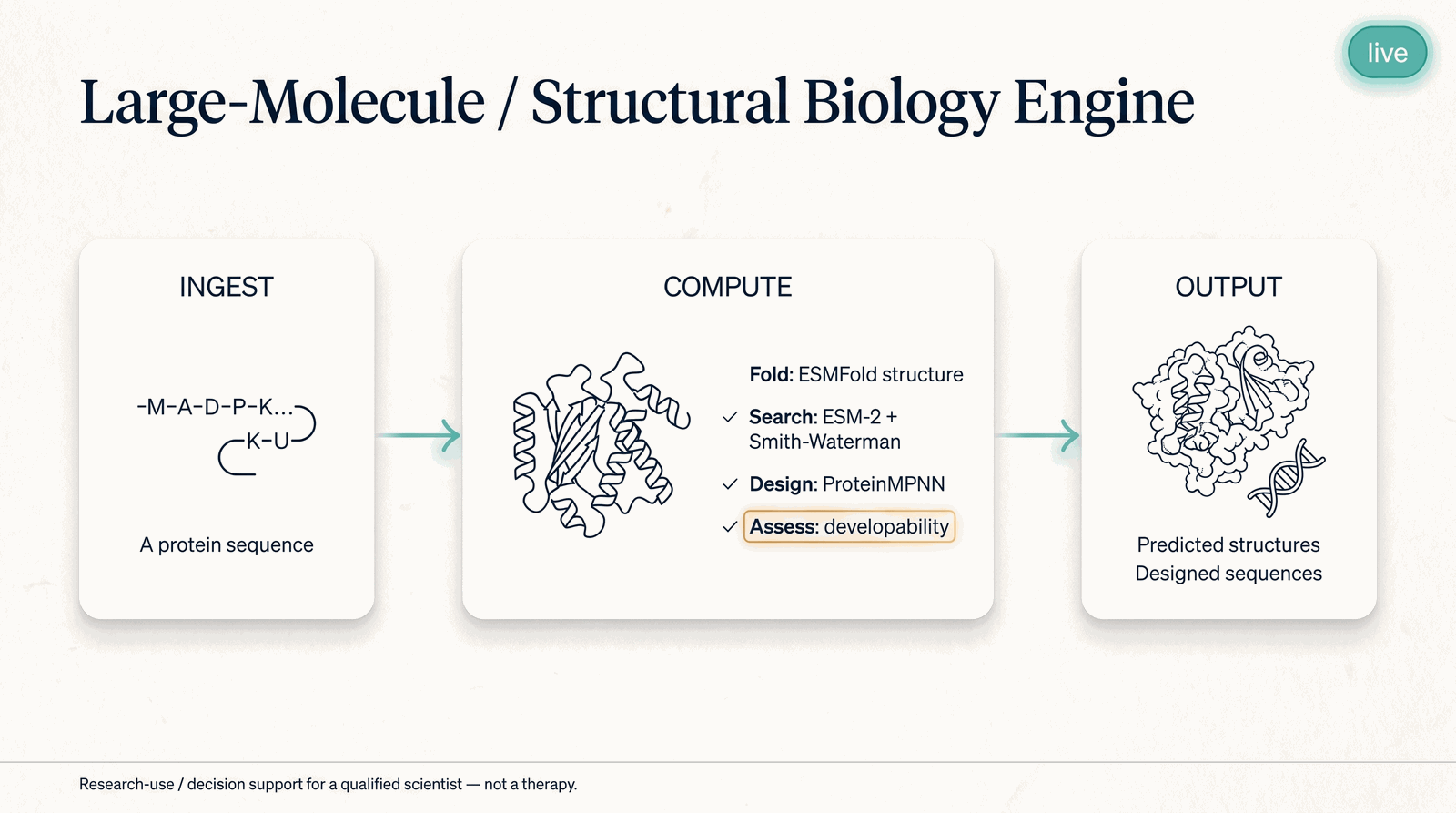
Illustrative. Decision support for a qualified clinician — never autonomous diagnosis or prescribing.
In plain terms
Proteins are the machines of biology — and the targets and the modality of large-molecule medicines like antibodies and cell therapies. The Large-Molecule / Structural Biology Engine is the factory's protein workbench: it predicts a protein's 3-D structure from its sequence, searches for related proteins, designs new sequences, and assesses whether a candidate is manufacturable and safe to the immune system.
Why it matters
Reading a protein's structure and reasoning about how to change it used to take a lab weeks. Doing it in seconds, on real models, is what makes computational biologics and binder design possible — and it is the substrate the therapeutic-discovery and cell-therapy work builds on.
For a patient: the protein groundwork behind the next generation of biologics and cell therapies designed for their disease.
How it works
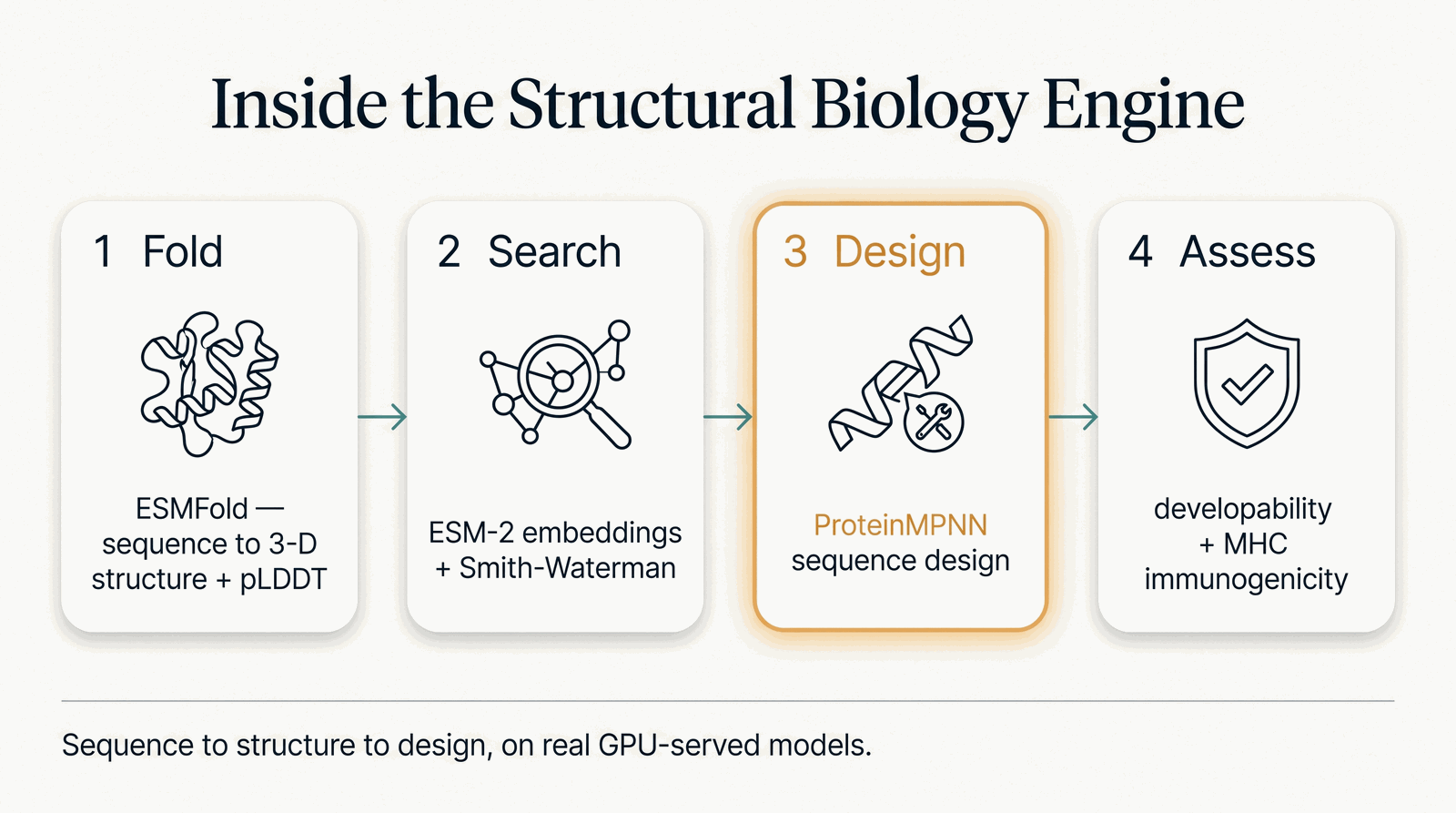
Sequence → structure → design → developability, on real GPU-served models. Illustrative.
- Fold — ESMFold predicts a single protein's 3-D structure from its sequence, with a per-residue confidence score (pLDDT). (verified on real sequences.)
- Search — ESM-2 embeddings plus Smith-Waterman alignment find related proteins by sequence and by learned similarity. (verified.)
- Design — ProteinMPNN designs new amino-acid sequences that should fold to a desired backbone. (verified.)
- Assess — developability and MHC-immunogenicity checks flag whether a candidate is manufacturable and unlikely to provoke an immune response.
What goes in, what comes out
- In: a protein sequence (or a backbone to design onto).
- Out: a predicted structure, similarity search hits, designed sequences, and developability / immunogenicity scores.
Where it fits
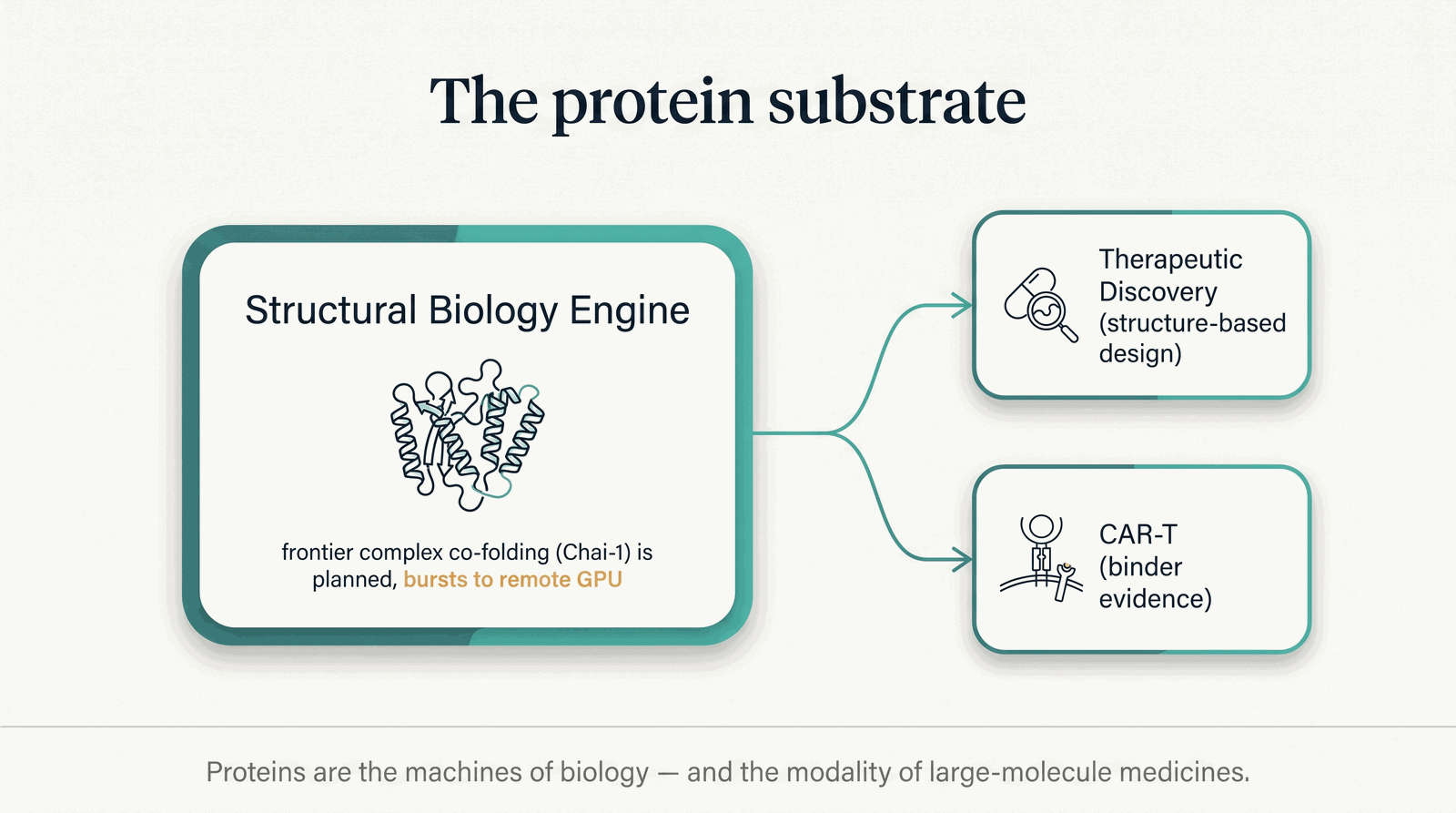
The protein substrate under structure-based drug design and biologic/binder work. Illustrative.
Its structures and designs feed the Therapeutic Discovery Engine (structure-based design) and the CAR-T Intelligence Agent (binder evidence), and support the oncology, autoimmune, and rare-disease work.
Honest limits
- What's verified vs. planned. ESMFold, ESM-2 search, and ProteinMPNN are
verifiedon real data. MHC immunogenicity (MHCflurry), ESM-2 fine-tune, and protein developability areplanned— their dependencies aren't yet installed in the runtime. - Frontier co-folding is separate. AlphaFold3-class complex co-folding (Chai-1) — which
ESMFold's single-sequence folding can't do — is
plannedand bursts to a remote GPU; de-novo binder design (Chai-2) isgated. - Research-use / decision support. Structures and designs are research and design outputs for a qualified scientist — not a therapy, and not a clinical diagnosis.
Interface
- Endpoint:
localhost:8581· Invoke path:/ - Serving: container · GPU: yes · Cost class: —
Inputs
| Name | Shape | Semantic | Notes |
|---|---|---|---|
sequence |
scalar | protein_sequence |
Outputs
| Name | Shape | Semantic | Notes |
|---|---|---|---|
result |
map | protein_structure |
Tags: engine · structural-biology · proteins
↩ Back to the Engines index · the Capability Maturity Matrix · the Capability Brief.
Note
Status and interface are generated from the capability registry (lib/hcls_common/capabilities.json) — the site cannot claim ahead of the code. All clinical output is decision support for a qualified clinician, never autonomous diagnosis.