Single-Cell Analysis Engine
verified Domain: single_cell Type: engine
Engine 8 compute layer. Real scanpy scRNA-seq workflow (QC -> normalize -> HVG -> PCA -> Leiden clustering -> marker DE) + marker-based cell-type annotation. Verified on PBMC 3k: 2700 cells -> 9 clusters -> CD4 T / B / NK / CD14+ & FCGR3A+ Monocytes / Dendritic / Megakaryocytes. Produces the cell-type clusters the Single-Cell Intelligence Agent reasons over (the engine computes, the agent interprets) — and a shared capability other engines/agents can call (e.g. oncology TME, the multi-omics join). POST /analyze. GPU (rapids-singlecell) is the upgrade.
A narrated, captioned explainer. Decision support for a qualified clinician.
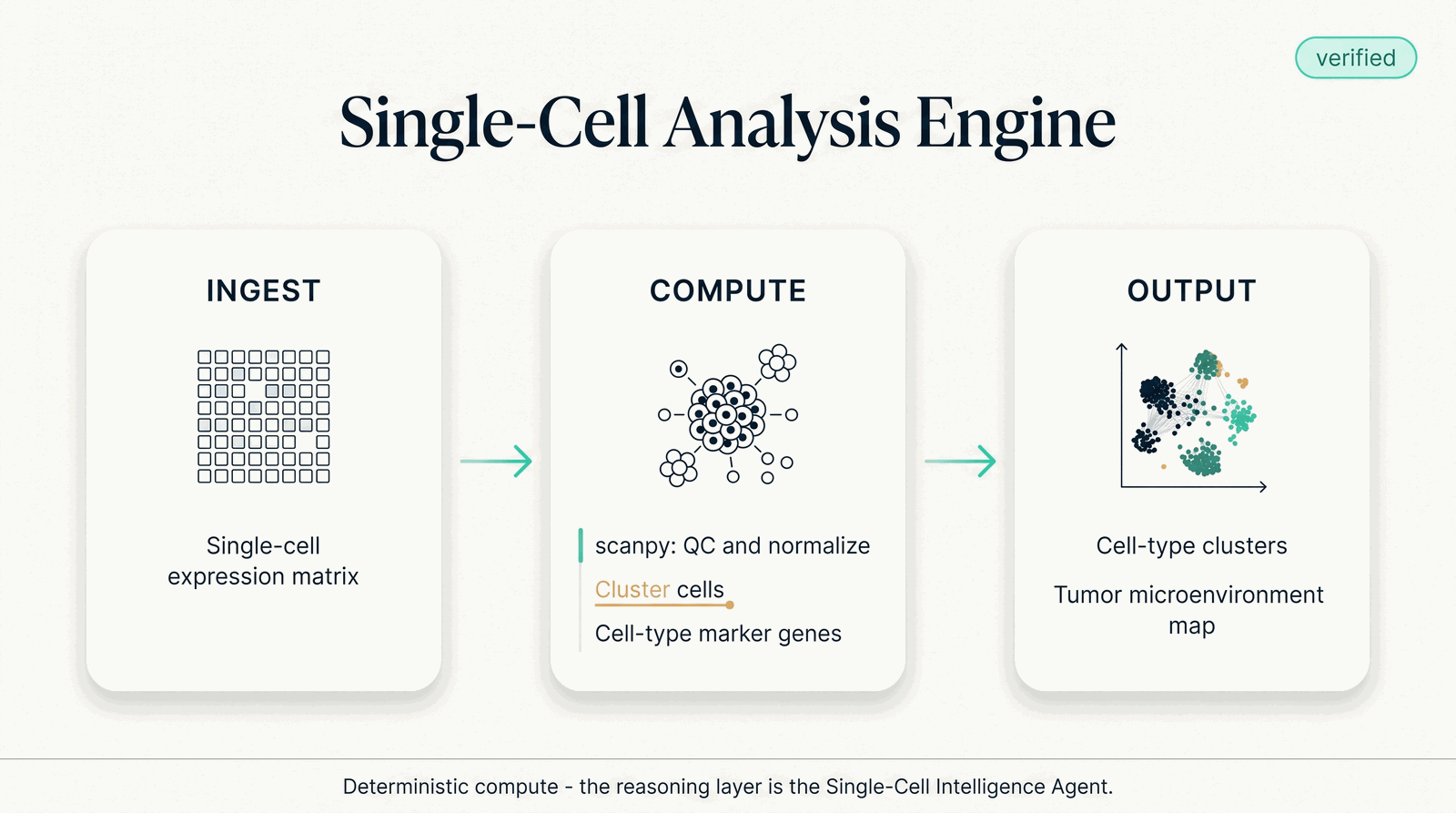
Illustrative. Decision support for a qualified clinician — never autonomous diagnosis or prescribing.
In plain terms
Every tissue is a mix of thousands of individual cells that are not all alike — an immune cell, a tumor cell, and a healthy cell can sit side by side. The Single-Cell Analysis Engine takes a dataset that measures gene activity one cell at a time (a single-cell expression matrix) and works out which cell types are present. It's a real, standard scientific workflow, built on the widely-used scanpy toolkit — the reliable compute step that turns a raw table of numbers into a labeled map of cells.
Why it matters
Knowing exactly which cells are in a sample — and, for a tumor, which immune cells surround it — is the foundation of cancer, immunology, and cell-therapy work. This engine is the honest, reproducible compute step that every higher-level single-cell interpretation depends on.
For a patient: knowing exactly which cells make up a tumor — including the immune cells around it — helps a clinician choose therapies aimed at the right cells.
How it works
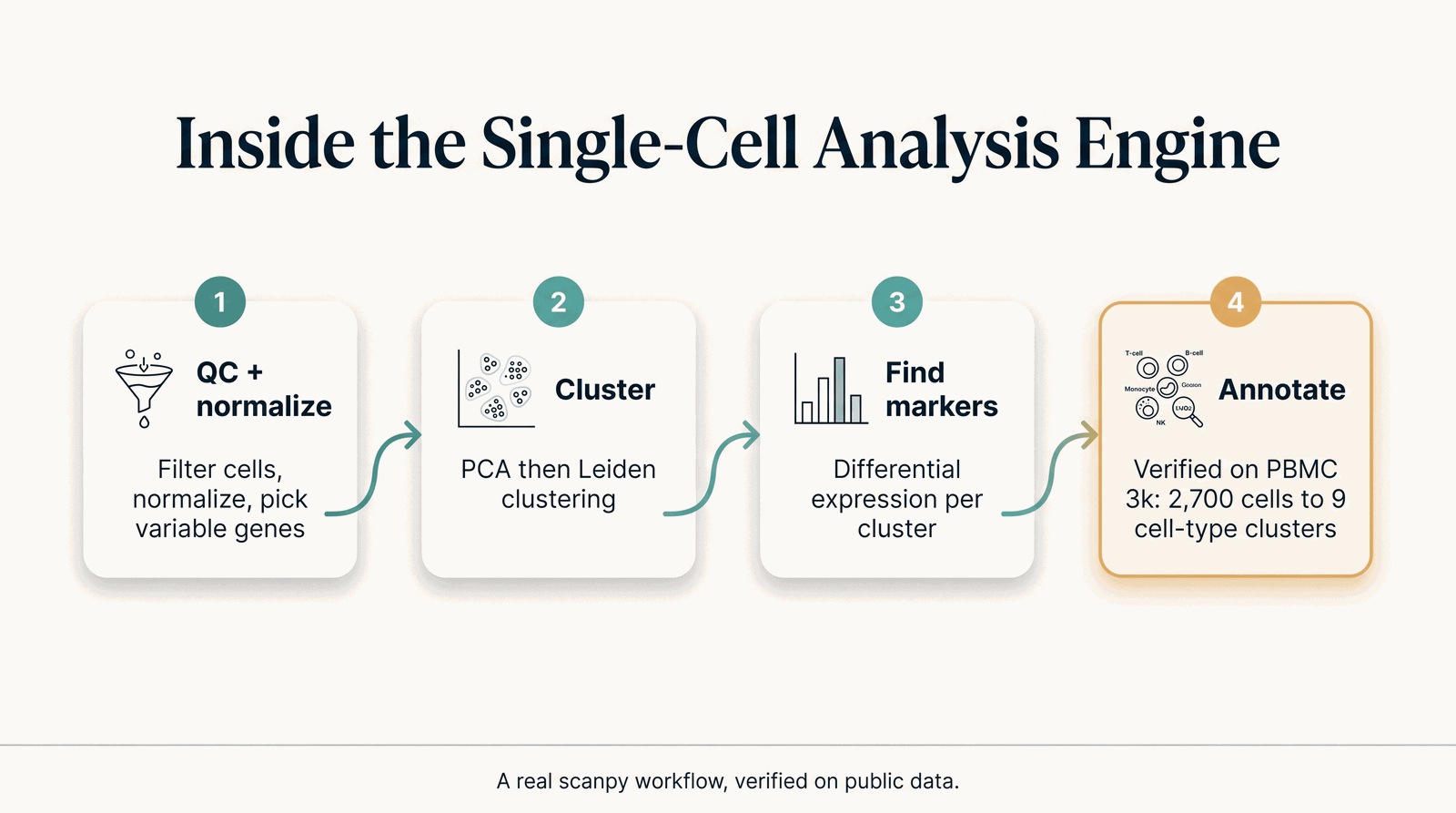
A real scanpy workflow: QC → normalize → cluster → annotate. Verified on PBMC 3k. Illustrative.
- QC & normalize — filter cells, normalize counts, select highly variable genes.
- Reduce & cluster — PCA, then Leiden clustering groups cells that behave alike.
- Find markers — differential expression surfaces each cluster's marker genes.
- Annotate — marker genes map clusters to cell types. Verified on the public PBMC 3k dataset: 2,700 cells → 9 clusters → CD4 T, B, NK, CD14+ and FCGR3A+ Monocytes, Dendritic, and Megakaryocytes.
What goes in, what comes out
- In: an expression matrix and a clustering resolution (
POST /analyze). - Out: cell-type clusters — a labeled cell map.
Where it fits
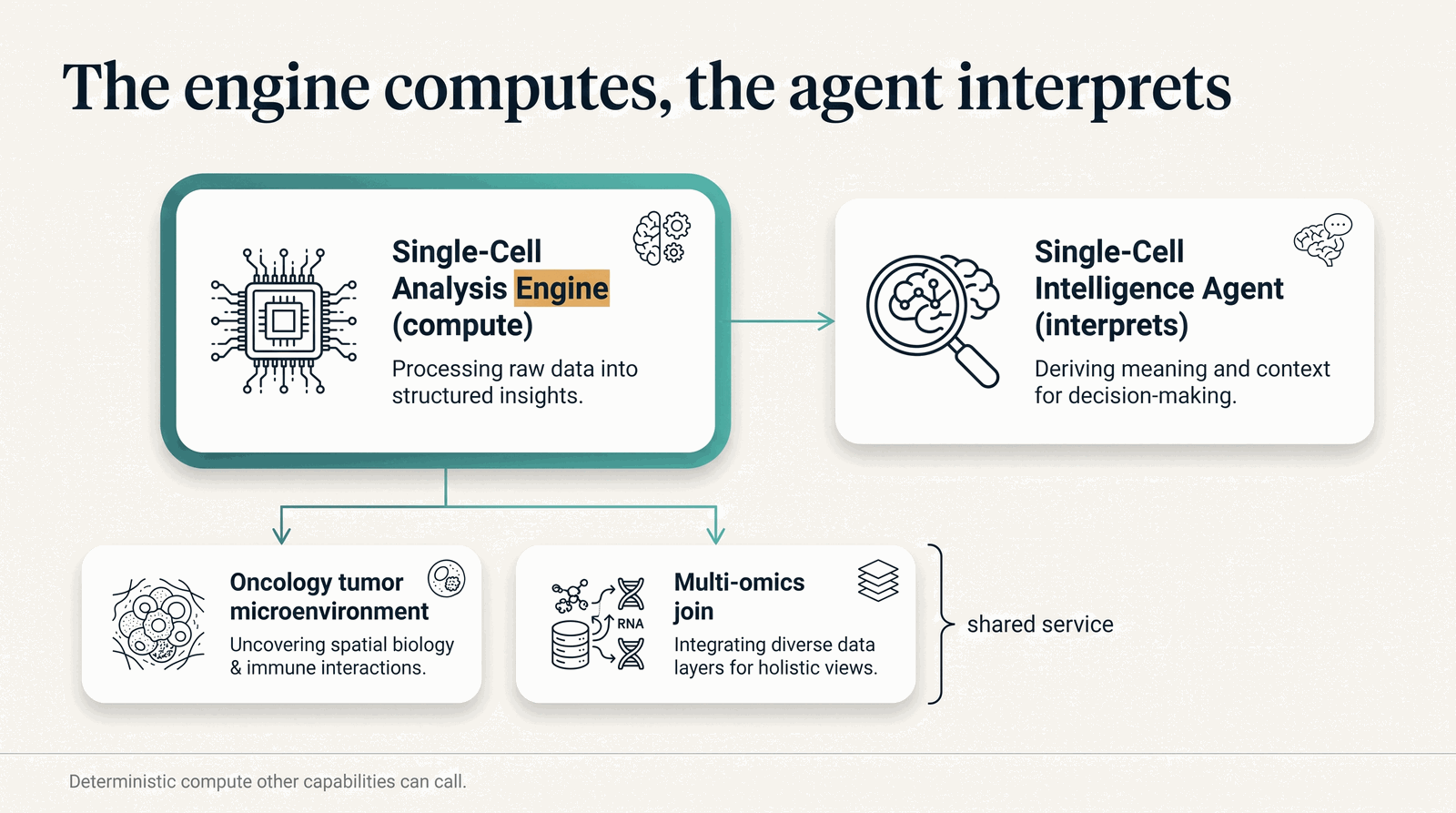
The engine computes; the Single-Cell Intelligence Agent interprets. A shared service others call. Illustrative.
It is the compute base beneath the Single-Cell Intelligence Agent — the engine computes, the agent interprets — and a shared service other capabilities call (e.g. the oncology tumor-microenvironment view and the multi-omics join).
Honest limits
- Verified on public data. Run end-to-end on the public PBMC 3k benchmark — about 2,700 human immune cells that researchers use as a standard, known-answer test — and it recovered exactly the cell types it should. Real-data evidence, not a claim.
- Deterministic compute, not reasoning. It computes clusters; interpretation is the agent's job.
- CPU today, GPU is the upgrade. It is CPU-served now; a GPU (
rapids-singlecell) path is the planned acceleration.
Interface
- Endpoint:
localhost:8573· Invoke path:/analyze - Serving: native · GPU: no · Cost class: medium
Inputs
| Name | Shape | Semantic | Notes |
|---|---|---|---|
expression_matrix |
file | expression_matrix | |
resolution |
scalar | — |
Outputs
| Name | Shape | Semantic | Notes |
|---|---|---|---|
clusters |
map | cell_map |
Tags: D1 · scanpy · cpu-served
↩ Back to the Engines index · the Capability Maturity Matrix · the Capability Brief.
Note
Status and interface are generated from the capability registry (lib/hcls_common/capabilities.json) — the site cannot claim ahead of the code. All clinical output is decision support for a qualified clinician, never autonomous diagnosis.