Tuberous Sclerosis Engine
live Domain: tsc Type: engine
Disease-program engine orchestrating 5 sub-agents (variant curator, trajectory modeler, therapeutics strategist, phenome mapper, TAND surveillance). Composes the horizontal engines/agents for TSC. Decision support, never autonomous diagnosis; pediatric caution at full force. Gene-therapy correction of TSC1/TSC2 is preclinical — the open design/analysis bench, not a cure today.
A narrated, captioned explainer. Decision support for a qualified clinician.
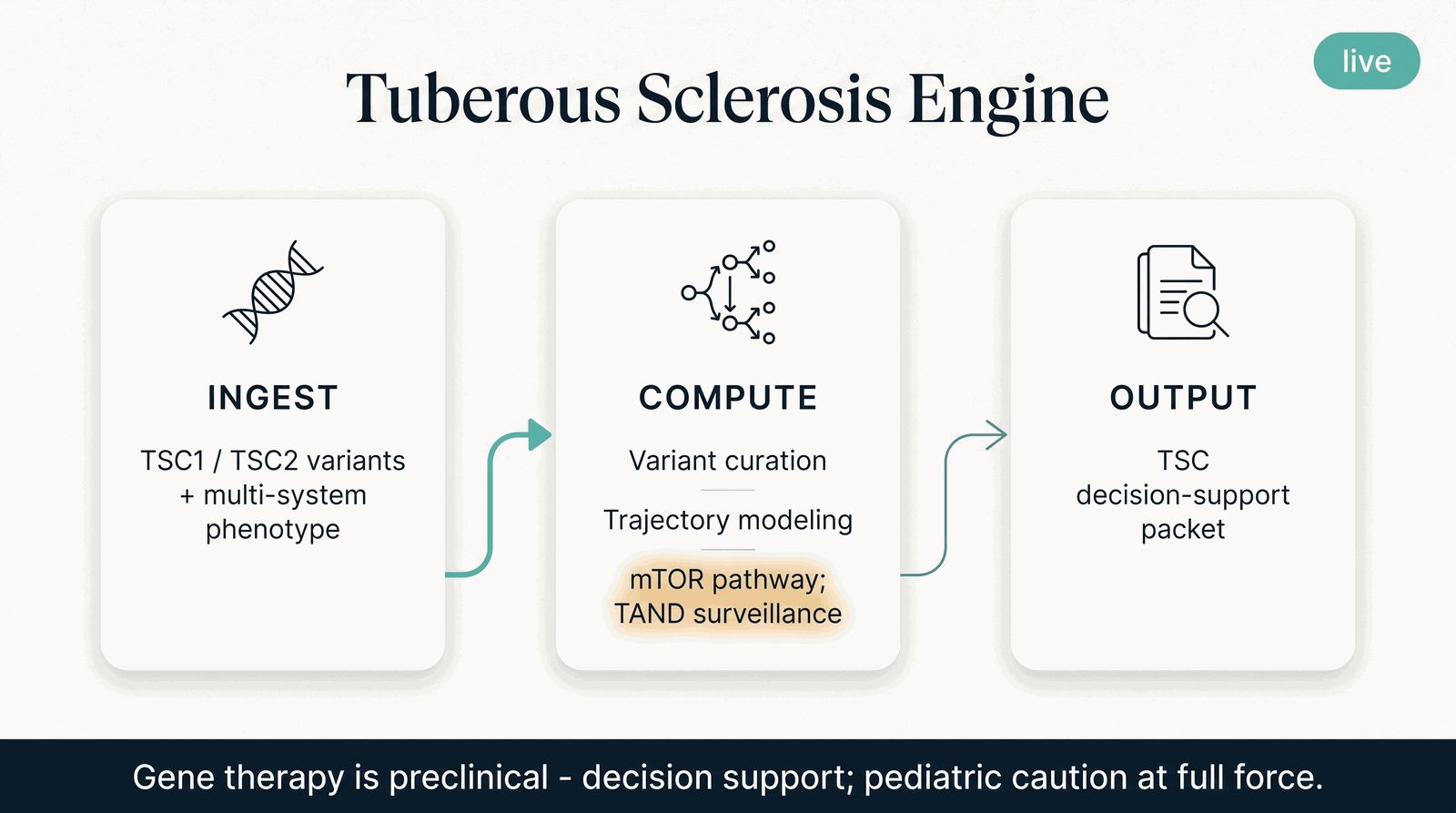
Illustrative. Decision support for a qualified clinician — never autonomous diagnosis or prescribing.
In plain terms
The Tuberous Sclerosis Engine is the factory's first disease program — the whole platform pointed at one condition. Where the other engines are horizontal capabilities, this is a vertical: it orchestrates five TSC-specific sub-agents and composes the horizontal engines and agents into one governed assessment for a single child.
Why it matters
Tuberous Sclerosis Complex is the ideal proving ground. It is multi-system — it touches brain, kidney, heart, skin, and lungs, so it lights up nearly the whole factory — and it has a clean gene-to-drug story: loss of TSC1/TSC2 drives mTORC1 hyperactivation, which the mTOR inhibitor everolimus targets (FDA-approved for TSC-associated SEGA in 2010, renal angiomyolipoma in 2012, and seizures in 2018).
For a child with TSC: their whole multi-system case reasoned through in one governed session, instead of months across many separate clinics.
How it works
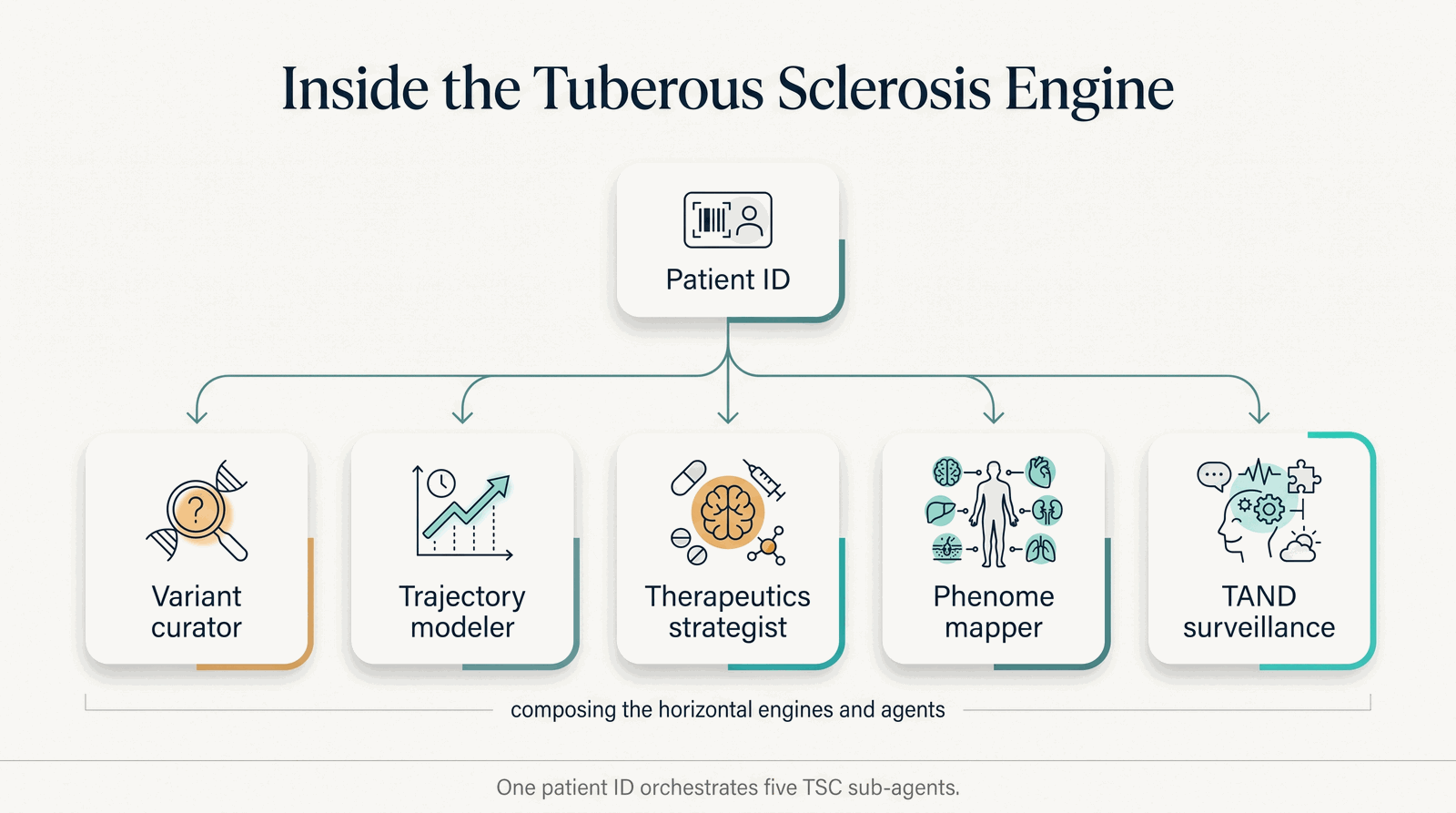
One patient ID orchestrates five TSC sub-agents across the horizontal engines. Illustrative.
From a single patient ID, the engine orchestrates five disease-specific sub-agents, each composing the horizontal capabilities:
- Variant curator — curates the TSC1/TSC2 findings.
- Trajectory modeler — models the multi-system disease course.
- Therapeutics strategist — reasons over mTOR-pathway therapy.
- Phenome mapper — maps the multi-organ phenotype.
- TAND surveillance — tracks TSC-associated neuropsychiatric disorders.
What goes in, what comes out
- In: a patient ID.
- Out: a clinical narrative assessment composed across the factory.
Where it fits
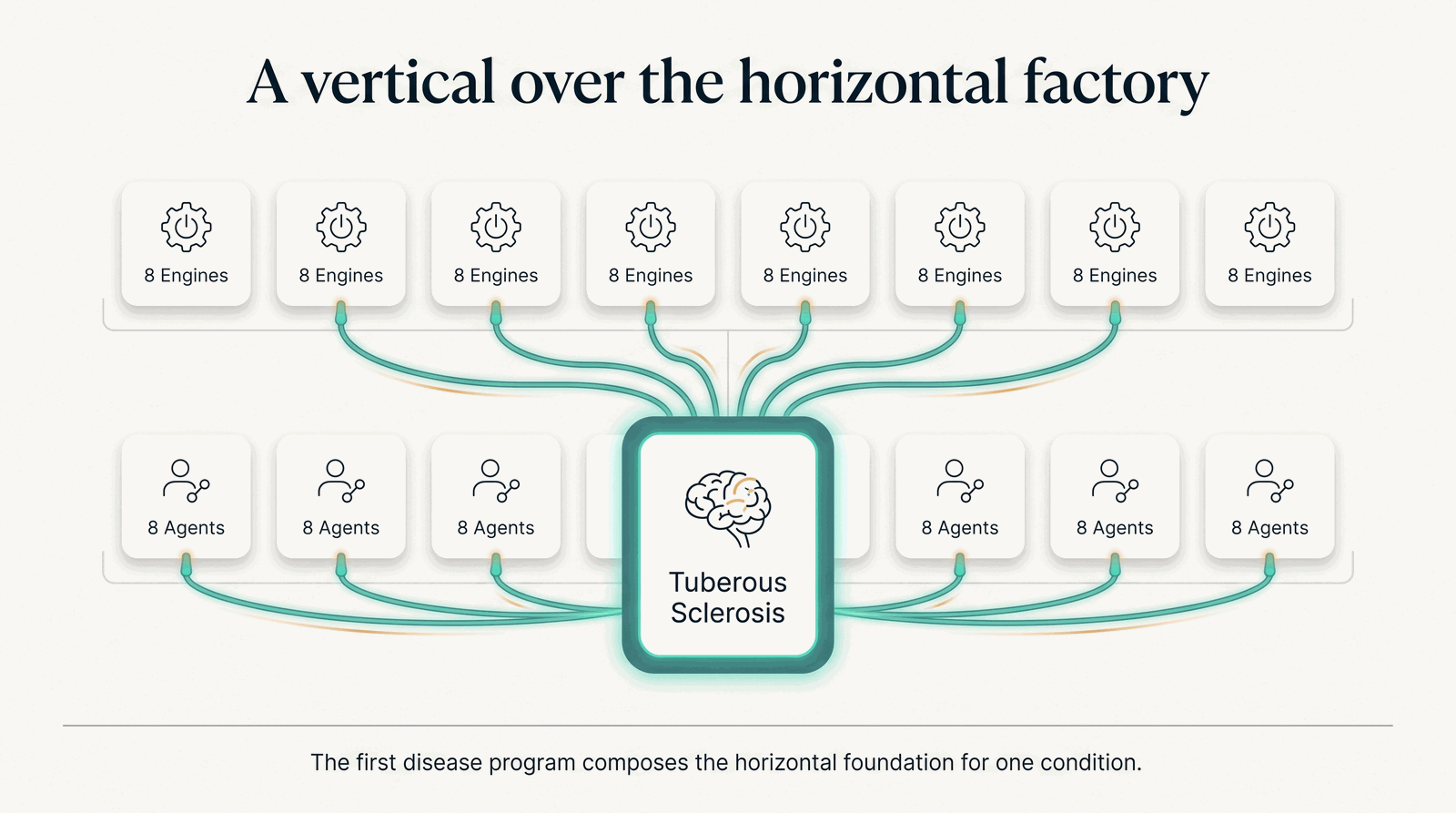
The first vertical: it composes genomics, interpretation, imaging, and the agents for one condition. Illustrative.
It is the vertical that composes the horizontal foundation — genomics, interpretation, imaging, and the specialist agents — into one condition's workflow, and the anchor of the factory's flagship demonstration.
Honest limits
- Gene therapy is preclinical. Gene-therapy correction of TSC1/TSC2 is preclinical — the factory is the open design and analysis bench, not a cure available today. Everolimus is the FDA-approved mTOR-inhibitor therapy.
- Pediatric caution at full force. This is a program for children; the honesty and safety discipline is held hardest here.
- Decision support, never autonomous. The assessment supports a qualified clinical team; it never diagnoses or treats on its own.
Interface
- Endpoint:
localhost:8560· Invoke path:/ - Serving: container · GPU: no · Cost class: —
Inputs
| Name | Shape | Semantic | Notes |
|---|---|---|---|
patient_id |
scalar | — |
Outputs
| Name | Shape | Semantic | Notes |
|---|---|---|---|
assessment |
map | clinical_narrative |
Tags: engine · tsc · disease-program
↩ Back to the Engines index · the Capability Maturity Matrix · the Capability Brief.
Note
Status and interface are generated from the capability registry (lib/hcls_common/capabilities.json) — the site cannot claim ahead of the code. All clinical output is decision support for a qualified clinician, never autonomous diagnosis.