One Platform — the glue
The engines compute and the agents reason, but they only become one factory because of a shared platform layer: a typed source of truth, a tool-surface, a composer, single-box MLOps, and the governance gates a composed run passes through.
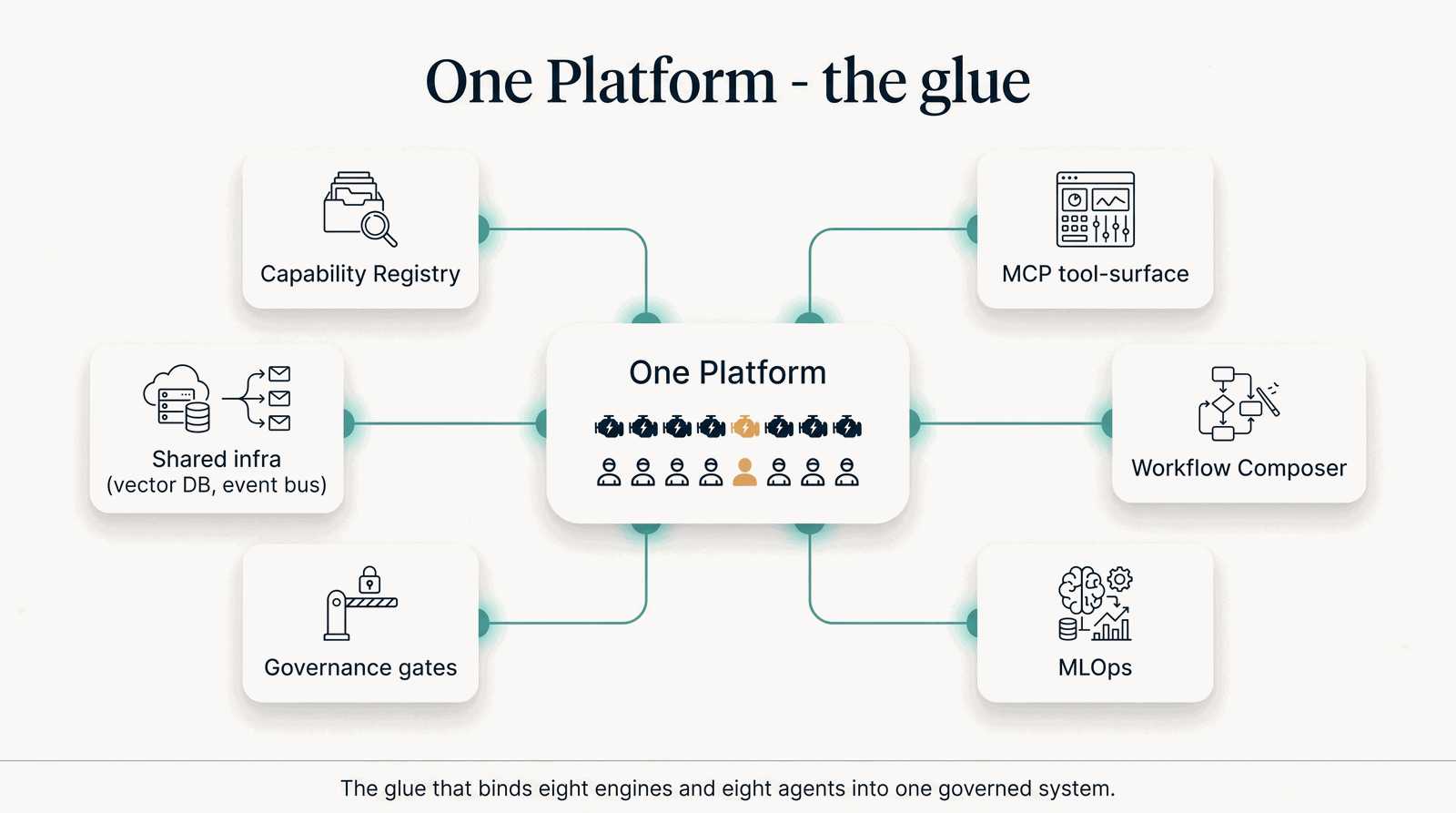
Illustrative diagram.
- Capability Registry — the typed source of truth for every engine, agent, model, and service.
A capability marked
liveis never mock-served; the maturity matrix and this whole site render from it, so nothing can be advertised that the code doesn't declare. - MCP Tool-Surface — every capability exposed as a governed tool an agent (or an external MCP client) can discover and call, fronted by the governance gates.
- Workflow Composer — turns a natural-language goal into a validated, governed pipeline by wiring capabilities along typed ports (a VCF output only connects to a VCF input).
- Single-box MLOps — model/versioning, runs, and lineage on one machine, with elastic burst to remote GPU for heavy or ARM-incompatible models.
- Governance Gates — the input-validation and output-honesty brackets, plus a deterministic lineage record (21 CFR Part 11-minded — traceable inputs, attributable steps, a reproducible hash — not a claim of Part 11 validation), that every run through the composer passes. Per-service adoption on the services' own HTTP routes is in progress, with the coverage stated.
Honest by construction
Because the registry is the single source of truth, the platform enforces the honesty rules
mechanically — a live capability cannot be mock-served, and verified cannot sit on anything
that isn't actually running. See Honesty & Governance.