NVIDIA BioNeMo
NVIDIA BioNeMo packages biology models as GPU-accelerated inference microservices (NIMs) that the factory calls on demand. Its models power the Therapeutic Discovery Engine's generate → dock → score loop, connected as one of the Frontier Models via elastic burst.
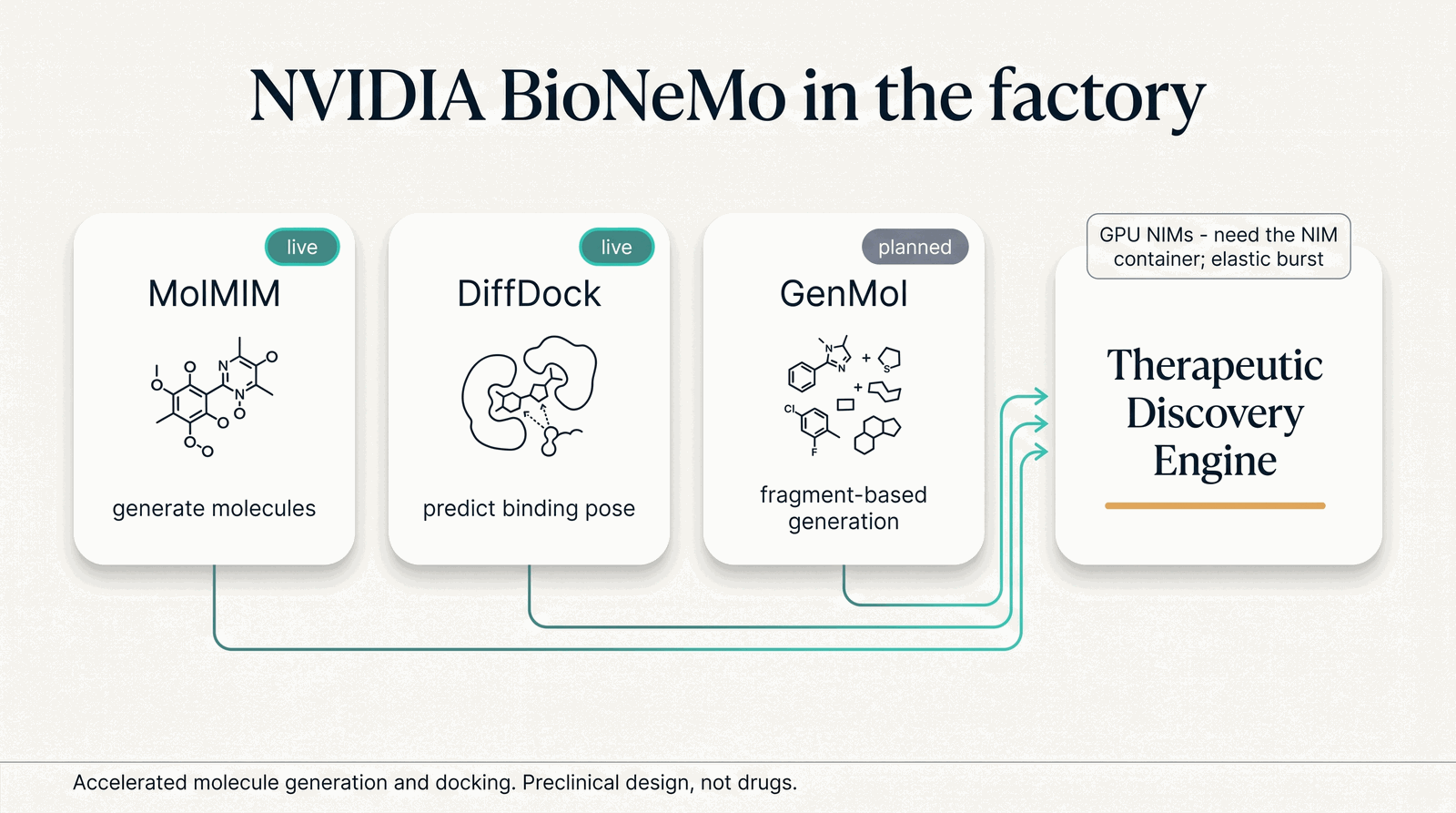
Illustrative. MolMIM and DiffDock are live clients (they need the NIM container); GenMol is planned.
Where it plugs in
| Model | Role | Status |
|---|---|---|
| MolMIM | Generative small-molecule design from a seed compound. | live |
| DiffDock | Protein–ligand docking and 3-D pose prediction. | live |
| GenMol | SAFE-fragment molecule generation (a diversity complement to MolMIM). | planned |
All three serve the Therapeutic Discovery Engine — MolMIM and DiffDock as the generation and docking stages, GenMol as a planned diversity generator.
Working with Chai Discovery
BioNeMo and Chai Discovery are the two halves of one design bench: BioNeMo builds and docks small molecules; Chai predicts and validates structures. Chained, they close a loop neither can on its own.
A ~90-second walkthrough: BioNeMo generates and docks a small molecule, Chai-1 co-folds it for an independent structural check, and Chai-2 opens a parallel biologic lane. Roadmap where noted — decision support, not diagnosis.
- Generate → dock → structurally validate. MolMIM (or RDKit BRICS) proposes molecules and DiffDock predicts a binding pose — then Chai-1 co-folds that top candidate inside its target's pocket, an independent, structure-based second opinion on the docking. Two different methods agreeing on the same pose is far stronger evidence than either alone.
- A parallel large-molecule lane. Where a target is better hit by a biologic than a small molecule, Chai-2 designs a de-novo binder and Chai-1 validates the complex — so the same target can be pursued as a small molecule (BioNeMo) or a biologic (Chai), side by side.
What the pairing enables:
| Engine / Agent | What BioNeMo + Chai unlock together |
|---|---|
| Therapeutic Discovery Engine | Small-molecule and large-molecule design under one roof, with Chai-1 as the shared structural validator for both. |
| Structural Biology Engine | BioNeMo's docked ligands get co-folded and cross-checked by Chai-1 — docking pose meets predicted complex. |
| Precision Oncology Engine | A tumor board can weigh both a small-molecule inhibitor (BioNeMo) and a biologic (Chai-2) against the same target, each with structural evidence. |
Honest about maturity
The small-molecule half runs today: MolMIM and DiffDock are live (they need the NIM container).
The moment the loop reaches Chai it becomes forward-looking — Chai-1 is planned, Chai-2 is
gated — so the integrated generate → dock → validate → design pipeline is a roadmap
capability, not a live one. Everything here stays preclinical decision support, and both Chai
stages burst to a remote GPU.
Honest limits
- Real clients, real dependency. MolMIM and DiffDock are
live— real client code — but they need the NVIDIA NIM container (NGC + GPU) deployed to actually run; a clearly-labeled mock fallback is used only in development. - The default generator is open. The engine's default, verified molecule generator is RDKit BRICS; MolMIM is the GPU-accelerated alternative when its NIM is deployed.
- Elastic burst. These are GPU microservices that run off the box, on demand — never pretending to run locally.
- Preclinical design, not drugs. Generated molecules and docking poses are preclinical design candidates — decision support for a scientist, not therapies.