Precision Oncology Engine
live Domain: clinical Type: engine
MTB packet generation, therapy ranking, and trial matching, with cross-modal joins to the imaging, biomarker, and trial capabilities; fusion-first pediatric MTB, late-effects-weighted ranking, Pediatric MATCH/COG matching. Decision support.
A narrated, captioned explainer. Decision support for a qualified clinician.
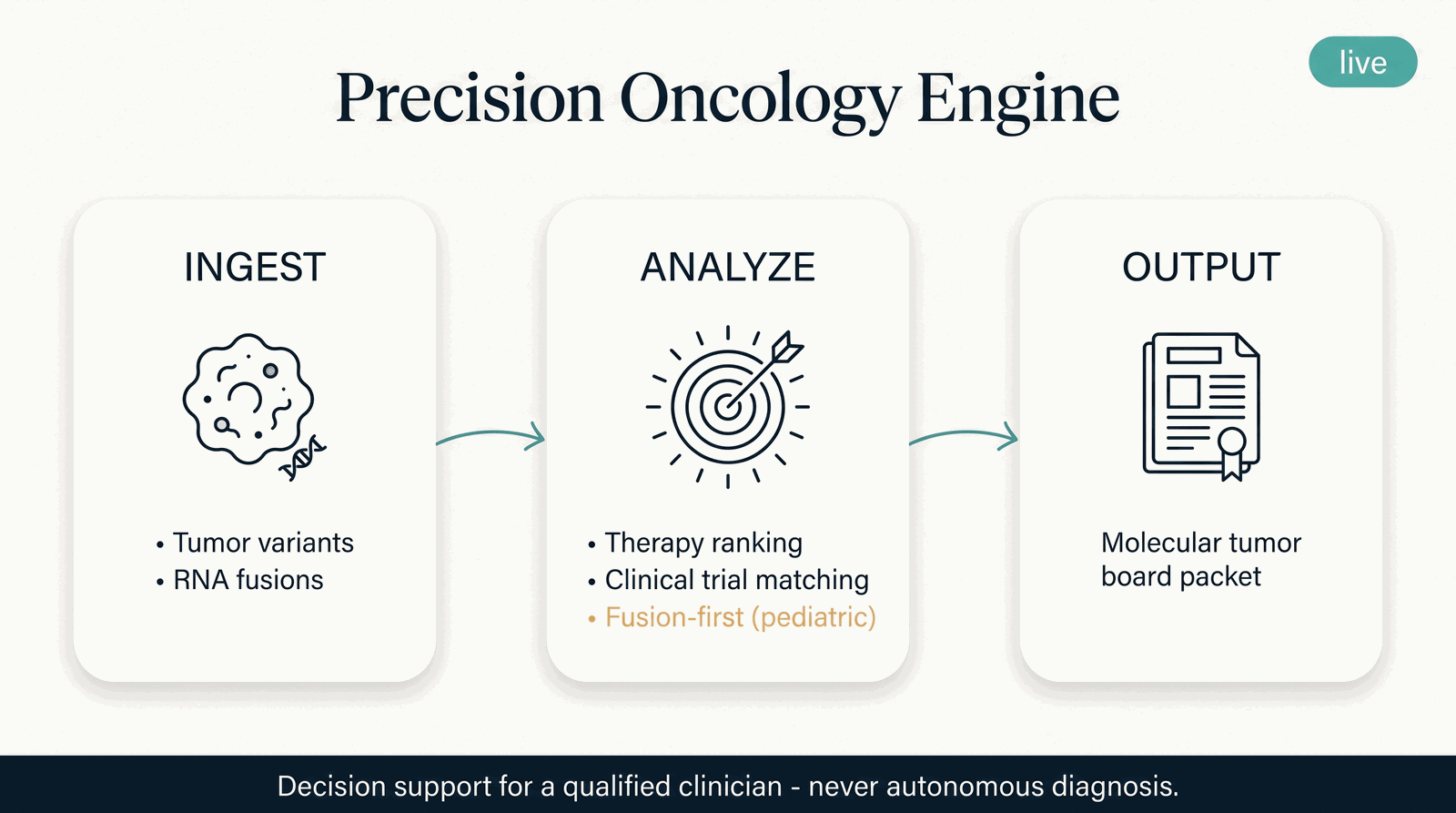
Illustrative. Decision support for a qualified clinician — never autonomous diagnosis or prescribing.
In plain terms
The Precision Oncology Engine assembles a molecular tumor board (MTB) packet: it ranks candidate therapies and matches clinical trials for a cancer patient, then packages the reasoning for a human tumor board to review. It is tuned for pediatrics — fusion-first, and weighted for the decades a child survivor will live.
Why it matters
Childhood cancers are often driven by gene fusions rather than the point mutations adult panels chase, and a pediatric survivor may live sixty years with the consequences of treatment. Ranking therapies without weighting those late effects is the wrong answer. This engine is built around both facts.
For a patient: a tumor-board packet tuned to their exact cancer — and, for a child, weighted to protect their decades ahead.
How it works
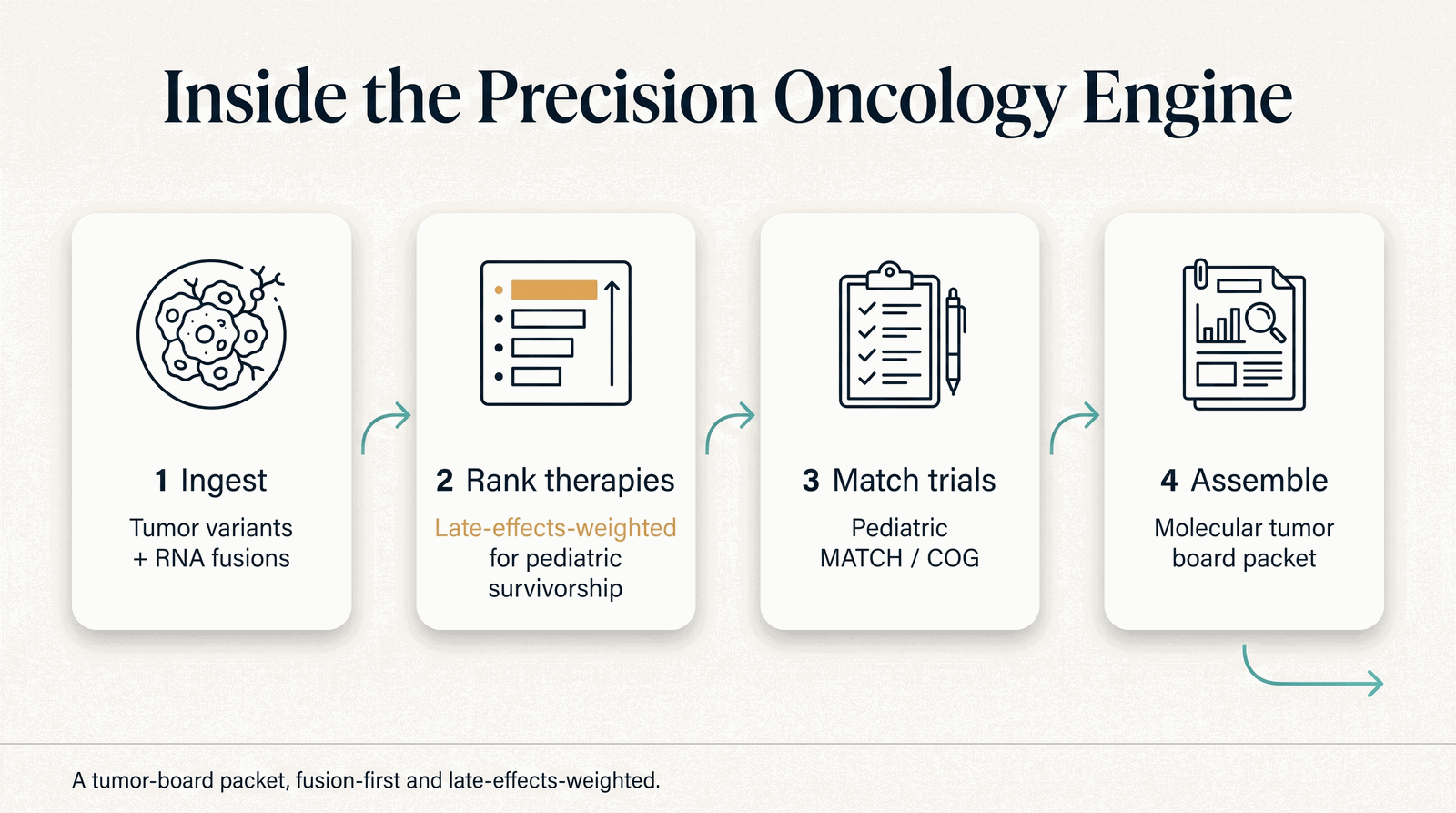
A molecular tumor board packet, fusion-first and late-effects-weighted. Illustrative.
- Ingest — tumor variants and RNA fusions, with the patient's context.
- Rank therapies — candidate therapies scored with late-effects weighting for pediatric survivorship.
- Match trials — trial matching against Pediatric MATCH / COG.
- Assemble — an MTB packet, built with cross-modal joins to the imaging, biomarker, and trial capabilities.
What goes in, what comes out
- In: a query and the patient context (tumor molecular profile).
- Out: an MTB packet for a human tumor board.
Where it fits
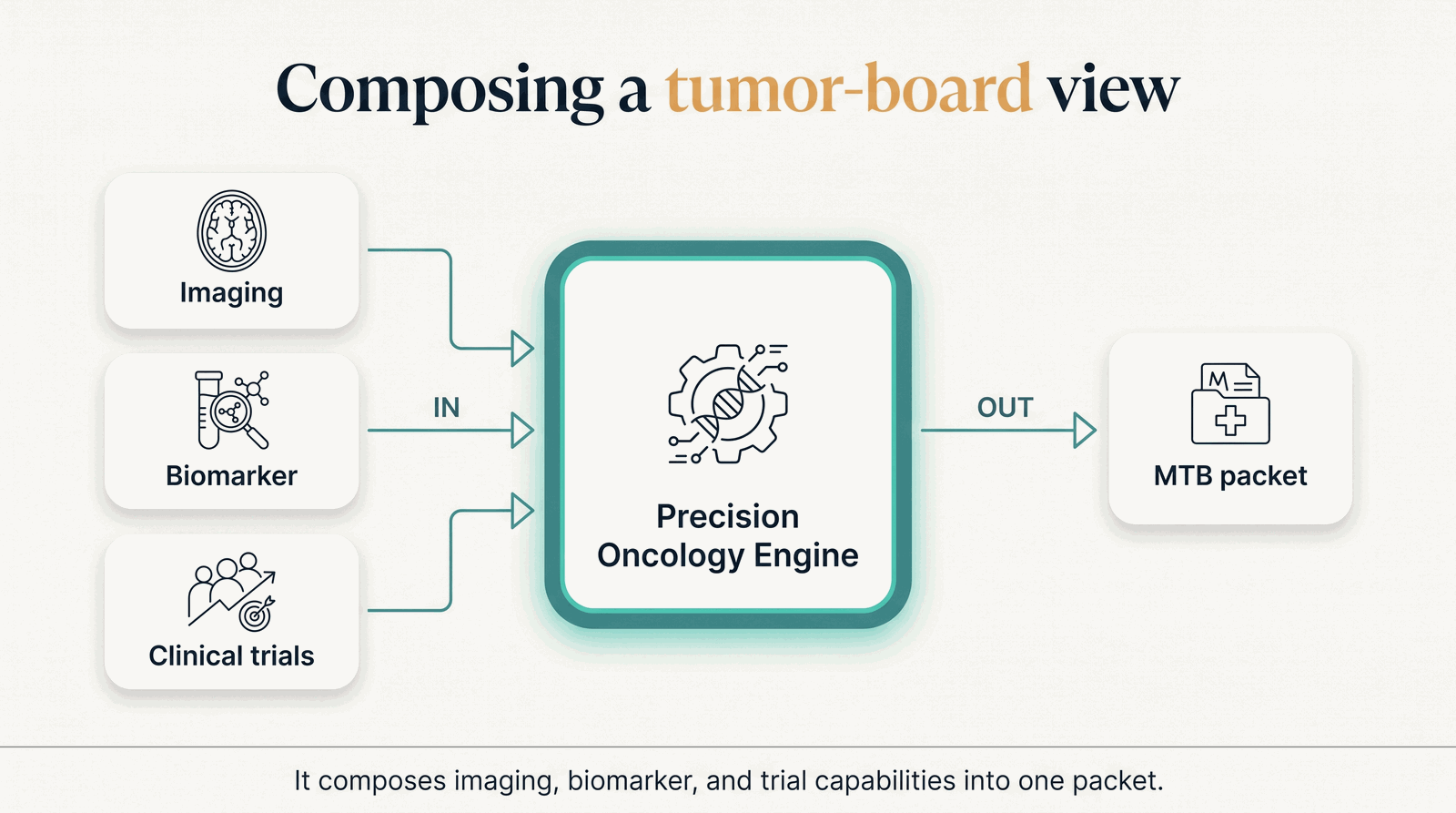
It composes imaging, biomarker, and trial capabilities into one tumor-board view. Illustrative.
It sits over the horizontal engines and agents, pulling imaging reads, biomarker profiles, and trial matches into a single packet — the heart of the pediatric molecular-tumor-board demonstration.
Honest limits
- A packet for a board, not a prescription. The output supports a qualified molecular tumor board; it is never an autonomous treatment decision.
- Decision support, always. Therapy ranking and trial matching are aids to expert judgment, cited to their guidelines and sources.
Interface
- Endpoint:
localhost:8526· Invoke path:/ - Serving: native · GPU: no · Cost class: —
Inputs
| Name | Shape | Semantic | Notes |
|---|---|---|---|
question |
scalar | — | Field name is question — verified against the live route, which rejects query with 422. |
patient_context |
map | patient_context |
Outputs
| Name | Shape | Semantic | Notes |
|---|---|---|---|
answer |
map | mtb_packet |
Tags: engine · oncology
↩ Back to the Engines index · the Capability Maturity Matrix · the Capability Brief.
Note
Status and interface are generated from the capability registry (lib/hcls_common/capabilities.json) — the site cannot claim ahead of the code. All clinical output is decision support for a qualified clinician, never autonomous diagnosis.