Precision Biomarker Intelligence Agent
live Domain: clinical Type: agent
RAG decision support over multi-omics and routine labs: biological-age clocks (PhenoAge, GrimAge), 9-domain disease-trajectory risk (diabetes, cardiovascular, liver, thyroid, iron, nutritional, kidney, bone, cognitive), critical-value alerting, reference-range interpretation, discordance detection across panels, and genotype-aware adjustment. The multi-omics join other capabilities draw on. Biological-age clocks are research-use, not clinical tests. Decision support for a qualified clinician, never autonomous diagnosis.
A narrated, captioned explainer. Decision support for a qualified clinician.
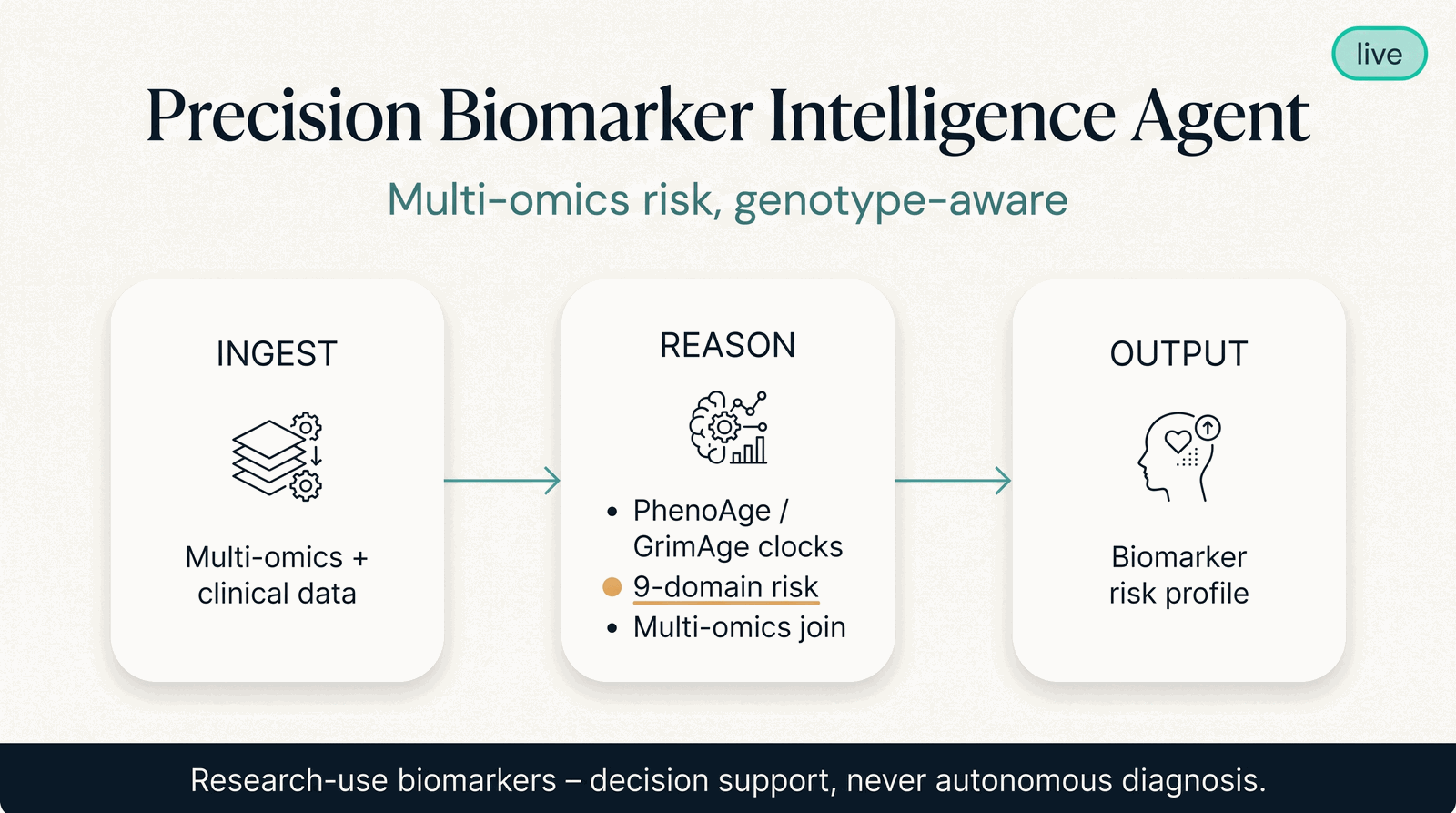
Illustrative. Decision support for a qualified clinician — never autonomous diagnosis or prescribing.
In plain terms
A biomarker is a measurable biological signal — something in your blood, genes, or cells — that hints at your health or your risk of disease. The Precision Biomarker Intelligence Agent pulls together many such signals from different layers of a patient's biology — multi-omics (looking at DNA, RNA, proteins, and more at once, rather than just one) — and turns them into one clear, explained risk profile a clinician can act on. Because the same measurement can mean different things depending on a person's genes, it keeps the patient's genetics in the loop — and it cites its sources rather than handing down a verdict.
Why it matters
A single lab value rarely tells the whole story: it can mean one thing in one person's genetic context and something else in another's, and the signal that matters is usually spread across several layers of biology at once. Joining them into one interpretable picture is what turns scattered measurements into something a clinician can actually use.
For a patient: a fuller, genetics-aware read of their biology — so risk is judged in context, not from one number in isolation.
How it works
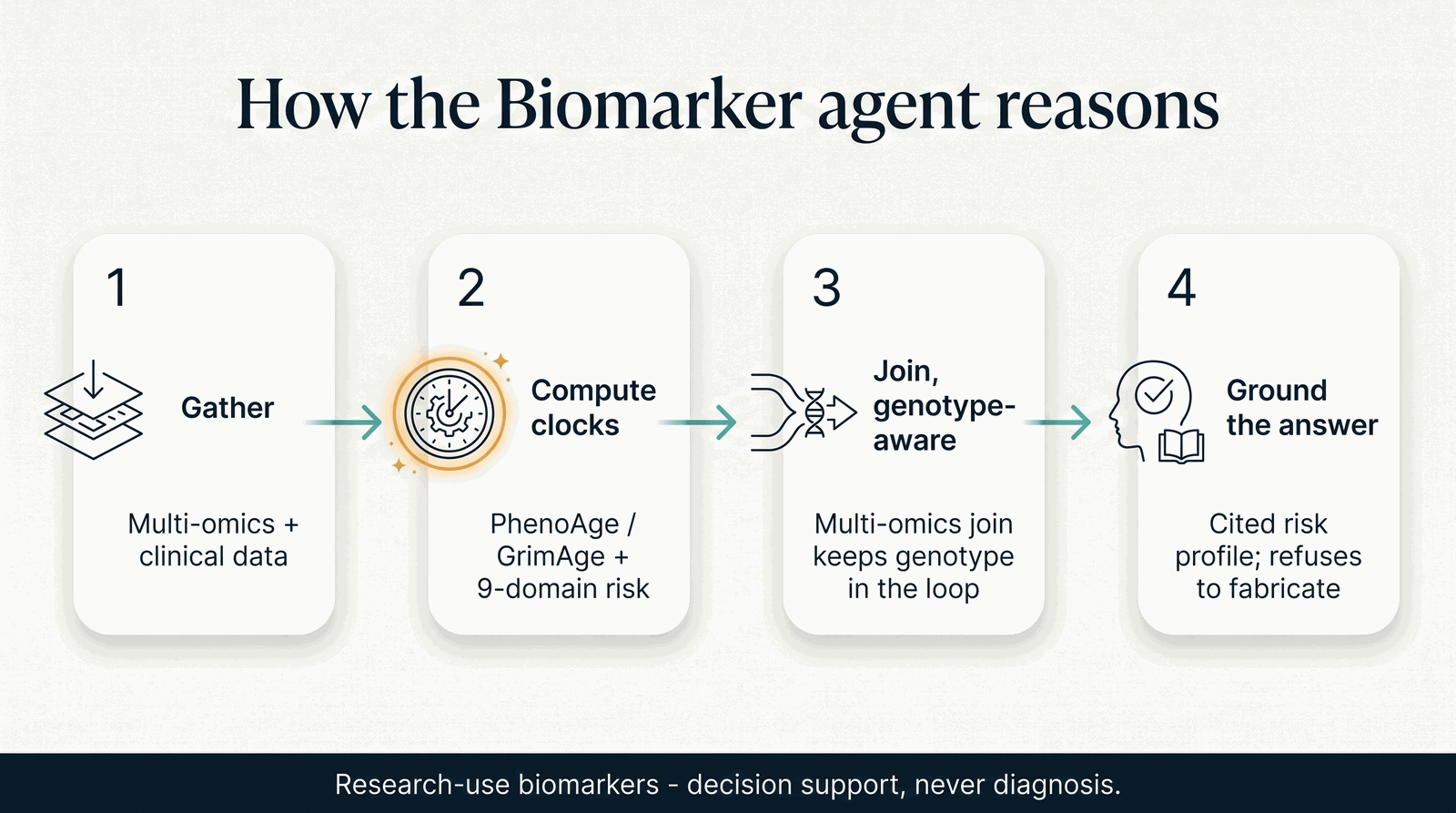
Multi-omics joined into a genotype-aware risk profile. Research-use, decision support. Illustrative.
- Gather — multi-omics and clinical data for the patient.
- Compute clocks — biological-age estimates (PhenoAge / GrimAge-style) and 9-domain risk.
- Join, genotype-aware — a multi-omics join that keeps the patient's genotype in the loop.
- Ground the answer — a cited risk profile; it refuses to fabricate where evidence is thin.
What goes in, what comes out
- In: a query and the patient context (multi-omics + clinical data).
- Out: a grounded, cited biomarker risk profile.
Where it fits
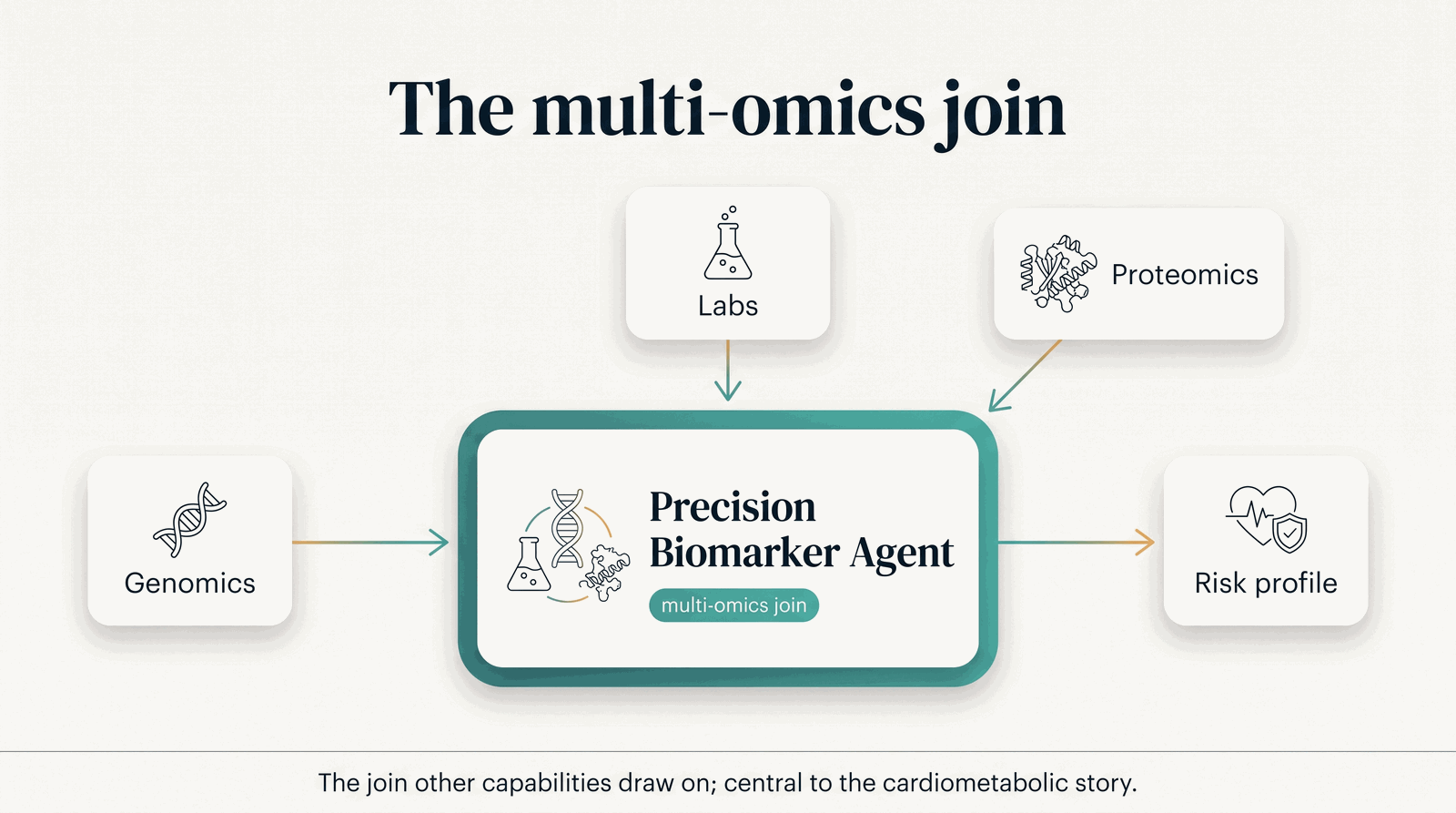
It performs the multi-omics join that other capabilities draw on; part of the cardiometabolic story. Illustrative.
It provides the multi-omics join other capabilities lean on and is central to the cardiometabolic / longevity demonstration.
Honest limits
- Research-use biomarkers. The biological-age clocks and multi-domain risk are research-use frameworks, not routine clinical diagnostics.
- Decision support, never diagnosis. It informs a qualified clinician; it does not diagnose.
- Grounded, and honest when it can't be. As a retrieval-augmented service it needs a populated vector database and an LLM API key at runtime, returning an honest degraded response (HTTP 503) rather than inventing content when they're absent.
Interface
- Endpoint:
localhost:8528· Invoke path:/ - Serving: native · GPU: no · Cost class: —
Inputs
| Name | Shape | Semantic | Notes |
|---|---|---|---|
question |
scalar | — | Field name is question — verified against the live route, which rejects query with 422. |
patient_context |
map | patient_context |
Outputs
| Name | Shape | Semantic | Notes |
|---|---|---|---|
answer |
map | biomarker_panel |
Tags: agent · biomarker
Runtime dependency
This agent is a Retrieval-Augmented Generation service: at runtime it needs a populated vector database and an LLM API key. When those are absent it returns an honest degraded response (e.g. HTTP 503) and never fabricates clinical content.
↩ Back to the Intelligence Agents index · the Capability Maturity Matrix · the Capability Brief.
Note
Status and interface are generated from the capability registry (lib/hcls_common/capabilities.json) — the site cannot claim ahead of the code. All clinical output is decision support for a qualified clinician, never autonomous diagnosis.