Skip to content
Open Source · Apache 2.0 · Powered by NVIDIA DGX Spark

Precision Medicine to Drug Discovery

Transform patient DNA into therapeutic molecule candidates in under 5 hours.
GPU-accelerated genomics, AI-powered reasoning, and generative drug discovery.

Scroll to explore

What It Is

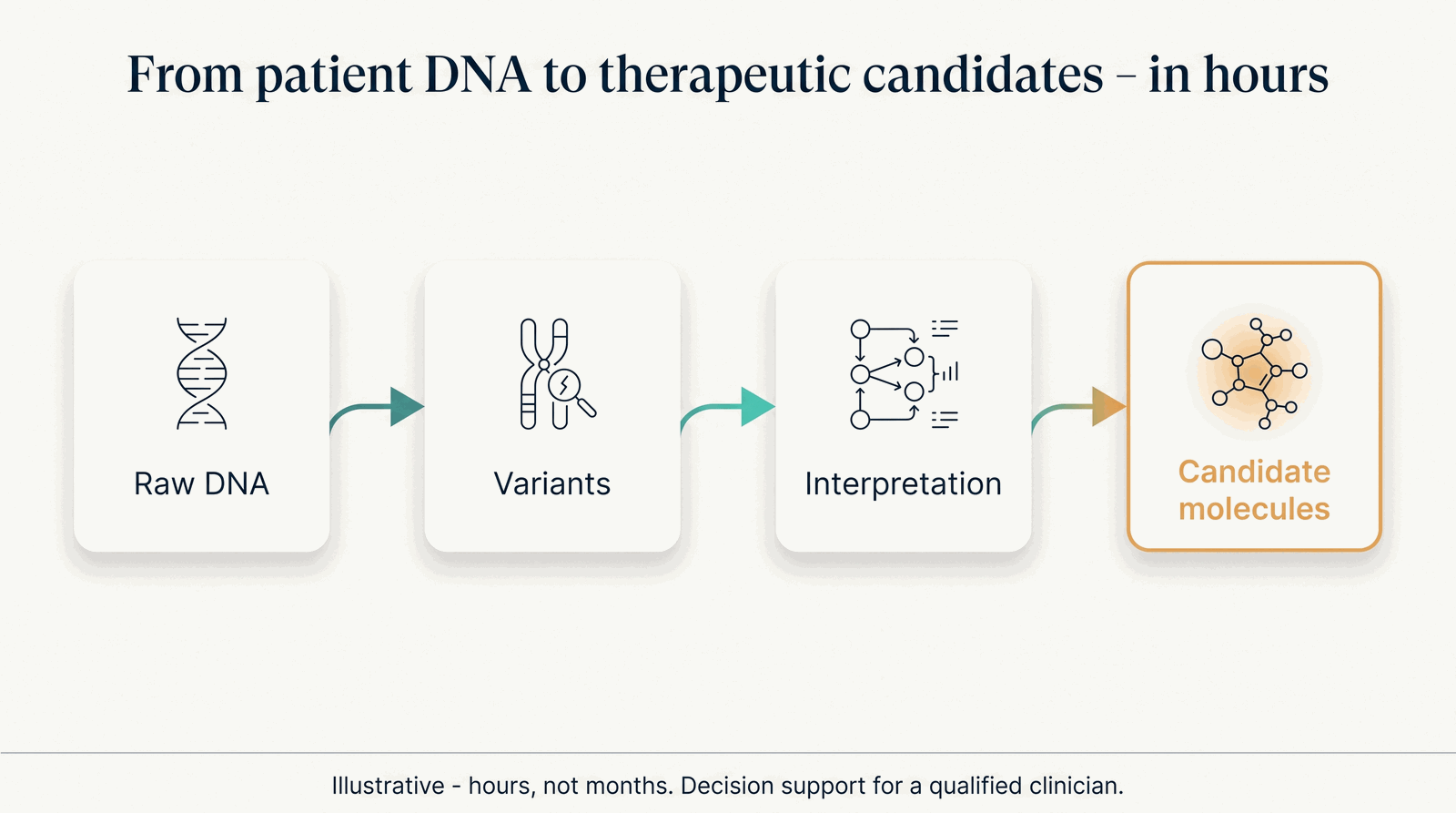
The Healthcare & Life Sciences (HCLS) AI Factory unifies three production-grade AI workflows into a single, continuous system — designed to take raw patient DNA and produce viable drug candidates without the fragmentation and delays that define traditional approaches.

This enables computational predictions. They're promising starting points for laboratory testing, not finished medicines. Real drug development requires years of laboratory and clinical validation. But what this HCLS AI Factory does is collapse the first and most expensive step — identifying targets and generating promising candidates — from months of work into hours.

Raw FASTQ files flow through NVIDIA Parabricks for GPU-accelerated genomics — alignment, variant calling, clinical-grade accuracy via DeepVariant — completing in hours instead of days.

Outputs feed directly into an evidence layer where millions of variants can be queried in natural language, grounded in ClinVar, AlphaMissense, structural data, and curated biomedical knowledge.

Validated targets then move into generative drug discovery via NVIDIA BioNeMo, where novel molecules are created, docked, scored, and ranked.

No batch jobs. No manual handoffs. Full lineage from patient DNA to candidate therapeutic.

One workstation. One workflow. Hours, not months.

Three-Stage AI Pipeline

End-to-end from raw sequencing data to drug candidates

01

GPU Genomics

200 GB FASTQ processed via NVIDIA Parabricks and DeepVariant. 11.7M variants called at >99% accuracy.

120 – 240 min
Explore pipeline →
02

Evidence RAG

3.5M variants annotated, embedded, and indexed. AI-powered reasoning identifies 171 druggable targets across 13 therapeutic areas.

Interactive
Explore pipeline →
03

Drug Discovery

BioNeMo MolMIM generates novel molecules. DiffDock predicts binding. RDKit scores drug-likeness. 100 ranked candidates per target.

8 – 16 min
Explore pipeline →

By the Numbers

Real results from a single NVIDIA DGX Spark workstation

11.7M
Variants Called
201
Genes · 13 Therapeutic Areas
85%
Druggable Targets (171 of 201)
< 5 hrs
End-to-End Runtime
$3,999
DGX Spark Hardware
100
Drug Candidates per Target

Traditional vs. HCLS AI Factory

What used to take months now takes hours

Metric Traditional Approach HCLS AI Factory
Sequence Alignment 12 – 24 hours 2 – 3 hours
Variant Calling 8 – 12 hours 1 – 2 hours
Annotation & Interpretation Days of manual work Minutes (automated)
Target Identification Weeks of literature review Minutes (AI-powered)
Drug Candidate Design Months of medicinal chemistry 8 – 16 minutes
Total Time Weeks to months < 5 hours
Infrastructure Cost $100K+ (cluster) $3,999 (DGX Spark)
Reproducibility Variable Deterministic

Origin

In 2012, I set out to use my high-performance computing background for something that mattered. I started with one conviction: no parent should ever have to lose a child to disease.

That conviction led me to Pediatric Neuroblastoma. I taught myself biology, genomics, molecular pathways, drug discovery — whatever the work required. I made one commitment early: I would not profit from this. Whatever I built, I would give away freely, so others could build on it and move faster than any one person ever could alone.

Thousands of hours later, this is the result.

— Adam Jones

Why This Is Open

This project is open by design, not as a shortcut or a visibility exercise, but as a deliberate decision about how foundational healthcare infrastructure should be built.

The challenges in precision medicine are no longer primarily scientific — they are architectural. Fragmented pipelines, opaque tooling, and closed systems slow the transition from genomic data to actionable insight.

By open-sourcing the HCLS AI Factory, this project provides a reproducible, inspectable reference implementation for end-to-end genomics, AI reasoning, and therapeutic exploration.

Open access to infrastructure knowledge accelerates progress, enables collaboration, and shifts innovation away from re-solving plumbing toward advancing care.

Who This Is For

For people and institutions working at the intersection of healthcare, life sciences, and AI who need systems, not abstractions.

Researchers & Bioinformaticians

Building, extending, or validating secondary genomics pipelines and variant interpretation workflows who need reproducible, inspectable infrastructure.

Clinicians & Translational Teams

Exploring how genomic data, AI reasoning, and therapeutic insights can be integrated into real-world decision-making.

Academic Medical Centers

Teaching, researching, or operationalizing genomics and AI at scale, where transparency, reproducibility, and extensibility are critical.

AI & Systems Engineers

Interested in how real biomedical workloads behave when treated as first-class AI systems, including data flow, orchestration, and reasoning layers.

Platform Builders

Designing future healthcare platforms who want a concrete reference architecture for AI-native pipelines rather than high-level diagrams.

Anyone, Anywhere

This project is not limited to a single specialty, disease, or institution. It is designed to be a shared foundation that can support many domains.

Architecture

Complete pipeline running on a single NVIDIA DGX Spark

HCLS AI Factory Architecture on NVIDIA DGX Spark

Click to explore the full architecture →

What This Is Not

The intent is clarity, not control.

Not a clinical product

It is a reference architecture and research platform, not a regulated medical device or diagnostic system.

Not a black-box AI solution

All workflows, data flows, and reasoning layers are inspectable and reproducible.

Not a replacement for expertise

It is designed to augment researchers and clinicians, not automate judgment.

Not a single prescribed workflow

The system is modular by design and intended to be adapted, extended, or specialized.

Not a vendor lock-in strategy

The architecture is deliberately vendor-neutral and infrastructure-agnostic.

Technology Stack

NVIDIA DGX Spark
Parabricks 4.6
DeepVariant
BWA-MEM2
BioNeMo MolMIM
DiffDock
Milvus 2.4
Anthropic Claude
RDKit
Docker Compose
Nextflow
Grafana
Prometheus
Streamlit
Flask

Take it. Use it. Make it better.

Everything is open source under Apache 2.0. Deploy the full pipeline on your DGX Spark in minutes.