Pharmacogenomics Intelligence Agent
live Domain: clinical Type: agent
RAG decision support for gene-guided prescribing across six workflows (gene, drug, profile, interaction, dosing, HLA screening): star-allele genotype to CPIC metabolizer phenotype (poor through ultrarapid), guideline-cited dosing, transporter function, HLA risk-allele screening, and phenoconversion from co-prescribed inhibitors/inducers. Its knowledge base carries 44 gene-drug pairs across 13 genes, each checked against CPIC. Decision support for a qualified clinician, never autonomous prescribing.
A narrated, captioned explainer. Decision support for a qualified clinician.
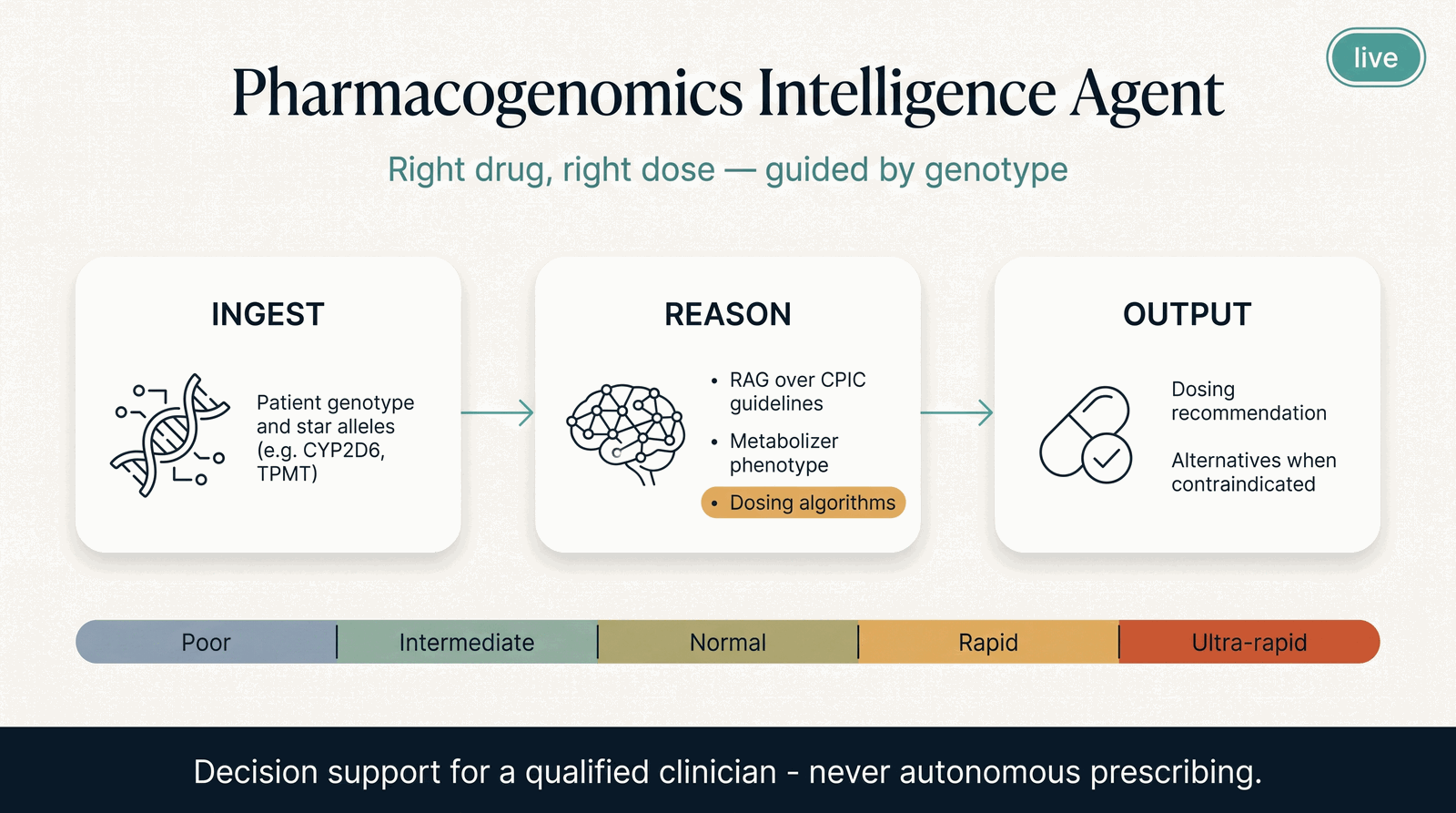
Illustrative. Decision support for a qualified clinician — never autonomous diagnosis or prescribing.
In plain terms
The Pharmacogenomics Intelligence Agent answers one deceptively hard question: given this patient's genes, which drug and what dose is safe? It reads a patient's pharmacogenes, works out how fast they metabolize a drug, and grounds a dosing recommendation in the published CPIC guidelines — as decision support for the prescriber, never an autonomous prescription.
Why it matters
The same standard dose can be ineffective in one person and toxic in another, purely because of inherited differences in drug metabolism. Adverse drug reactions are a major cause of preventable harm. Getting the drug-gene match right before the first dose is one of the most concrete wins in precision medicine.
For a patient: the right drug at the right dose from the first prescription — matched to how their body actually processes it.
How it works
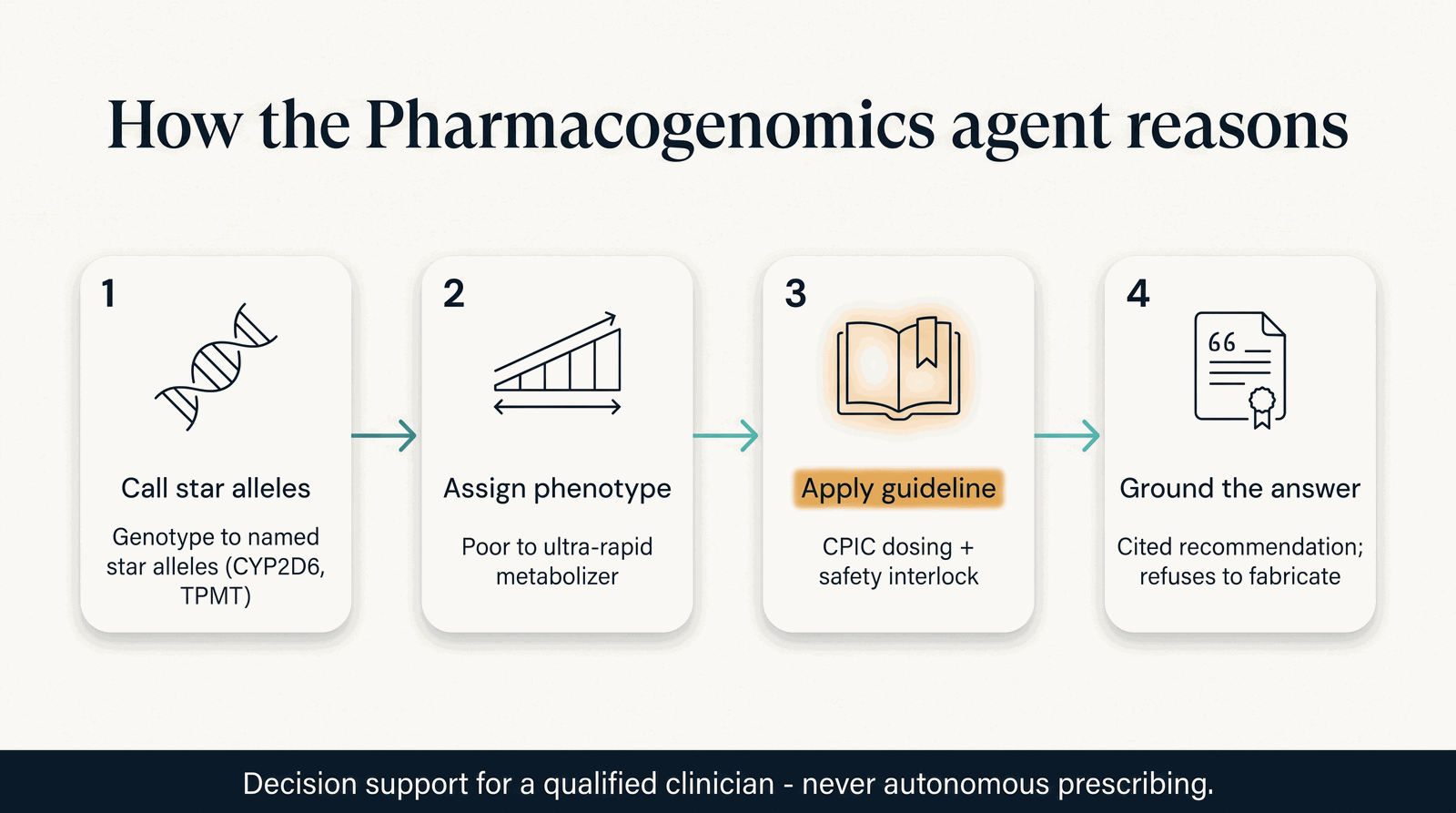
Genotype → metabolizer phenotype → guideline dose. Decision support, never autonomous prescribing. Illustrative.
- Call star alleles — the patient's drug-metabolism gene (e.g. CYP2D6, TPMT) is resolved into its named versions — star alleles, the standard shorthand (like *2 or *3) for the variants that change how fast that gene's enzyme works.
- Assign phenotype — those alleles map to a metabolizer phenotype (poor → ultra-rapid).
- Apply the guideline — the phenotype is matched to CPIC dosing guidance, with drug-metabolism filtering and a safety interlock.
- Ground the answer — retrieval-augmented generation returns a cited recommendation, refusing to fabricate when the evidence isn't there.
What goes in, what comes out
- In: a clinical query and the patient context (genotype).
- Out: a grounded, cited dosing answer for the clinician.
Where it fits
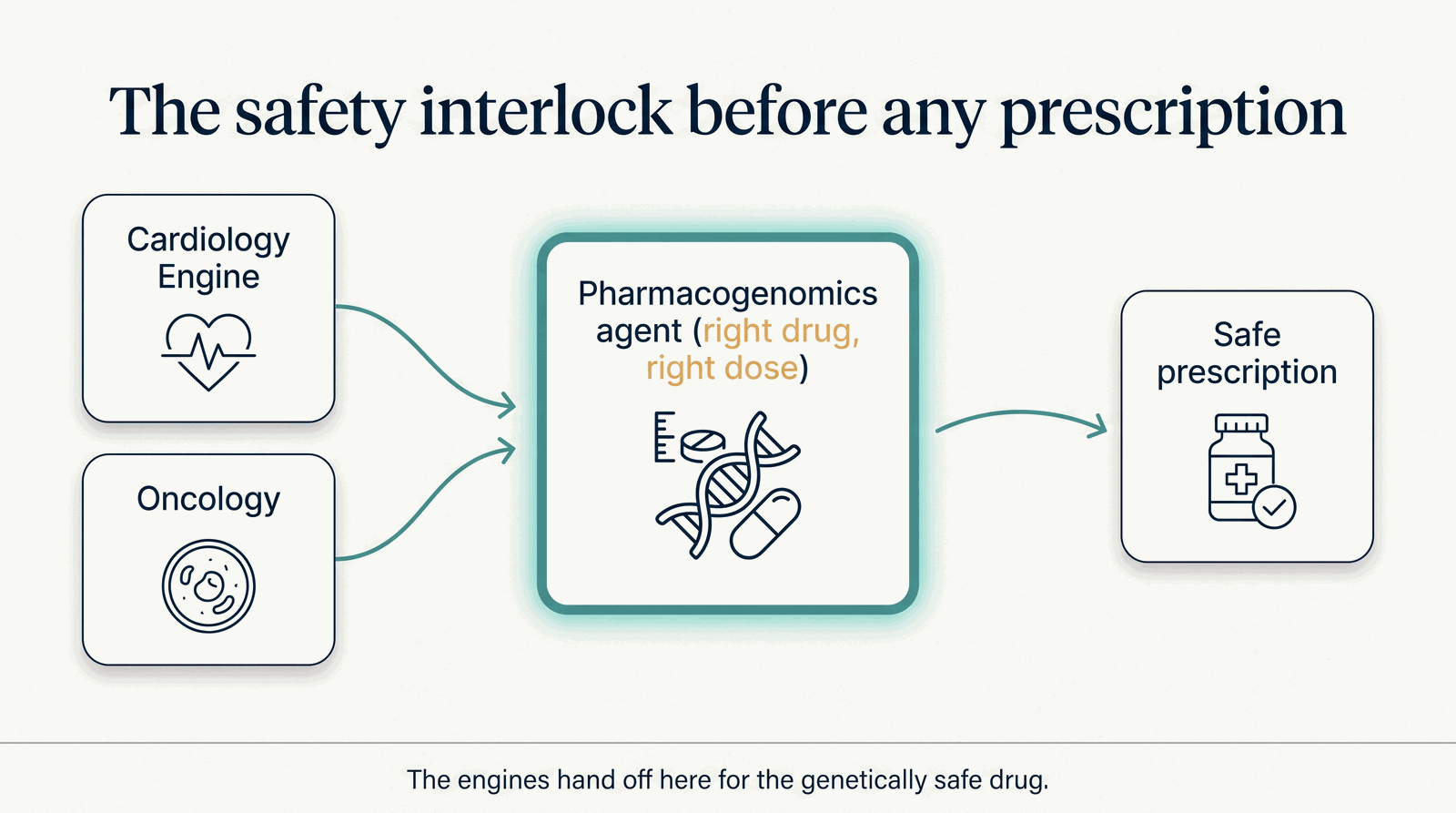
The right-drug-right-dose safety checkpoint the other engines hand off to. Illustrative.
It is the safety interlock: the Cardiology Engine and oncology hand off to it for the genetically safe drug, and it can flag any prescribing decision against the patient's metabolism — the prescriber still decides.
Honest limits
- Decision support, never prescribing. It informs a qualified prescriber; it does not prescribe.
- Grounded, and honest when it can't be. Like every intelligence agent it is a retrieval-augmented service: it needs a populated vector database and an LLM API key at runtime, and returns an honest degraded response (HTTP 503) rather than inventing clinical content when they're absent.
- Guideline-cited. Recommendations trace to CPIC; where guidance is absent, it says so.
Interface
- Endpoint:
localhost:8507· Invoke path:/ - Serving: native · GPU: no · Cost class: —
Inputs
| Name | Shape | Semantic | Notes |
|---|---|---|---|
question |
scalar | — | Field name is question — verified against the live route, which rejects query with 422. |
patient_context |
map | patient_context |
Outputs
| Name | Shape | Semantic | Notes |
|---|---|---|---|
answer |
map | pgx_verdict |
Tags: agent · pgx
Runtime dependency
This agent is a Retrieval-Augmented Generation service: at runtime it needs a populated vector database and an LLM API key. When those are absent it returns an honest degraded response (e.g. HTTP 503) and never fabricates clinical content.
↩ Back to the Intelligence Agents index · the Capability Maturity Matrix · the Capability Brief.
Note
Status and interface are generated from the capability registry (lib/hcls_common/capabilities.json) — the site cannot claim ahead of the code. All clinical output is decision support for a qualified clinician, never autonomous diagnosis.