Honesty & Governance
The honesty discipline is the load-bearing wall of this project. The site is built so it cannot claim more than the code delivers: statuses are rendered from the capability registry, and every limit is stated plainly where it matters.
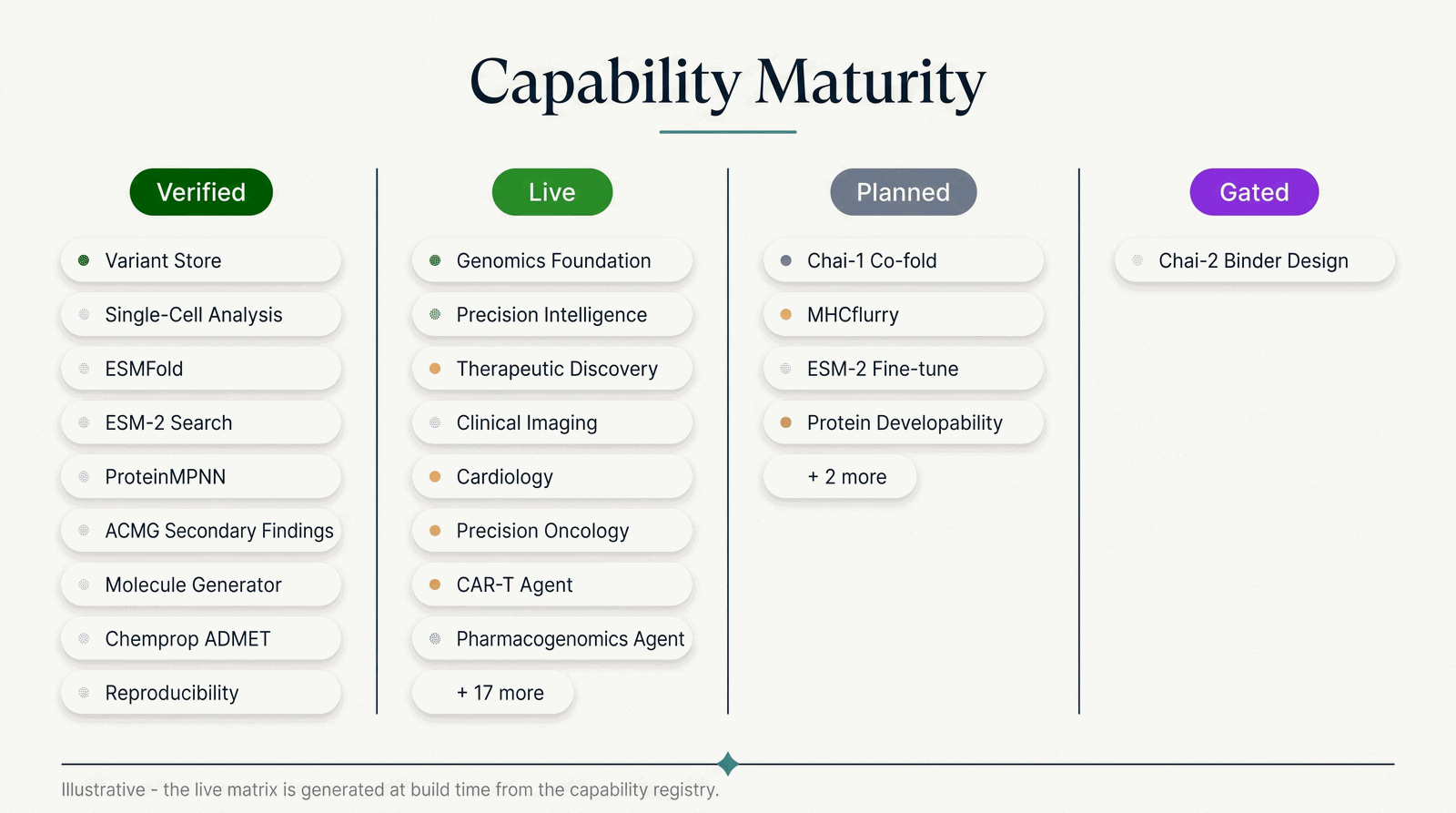
Illustrative. The live matrix below is generated at build time from the capability registry — it, not this diagram, is the source of truth.
- Capability Maturity Matrix — every capability's real status, generated
at build time from
lib/hcls_common/capabilities.json.
The four standing commitments
- Decision support, not diagnosis. Every clinical output supports a qualified clinician — never autonomous diagnosis or prescribing.
- A bench, not a cure. Where the factory points toward gene therapies, those are preclinical research — the promise of a direction, not a treatment available today.
- "Elastic burst," not "all on one box." Heavy or ARM-incompatible models burst to remote GPU over a private mesh; nothing pretends to fit on the desk that doesn't.
- Real, never mocked. A capability marked
liveis served by a real model against real input.
The honesty ledger
Carried everywhere it is relevant, stated out loud:
| Item | Honest status |
|---|---|
| Gene therapy for TSC1/TSC2 (and gene correction generally) | preclinical — open design/analysis bench, not a cure today |
| MAISI synthetic imaging | research / augmentation / QA use — never a diagnostic source |
Single-cell atlas-similarity search & cell-foundation embeddings (distinct from the verified single-cell compute engine) |
roadmap |
| Chai-2 de novo binder/antibody design | gated — partnership access; integration contingent |
| α-synuclein SAA · plasma p-tau217 · NSD-ISS / SynNeurGe staging | research- / trial-use inputs the agents reason over — not routine diagnostics |
| Frontier co-folding (Chai-1, RFdiffusion, Evo 2) | when stood up, run via elastic burst to remote GPU, never locally — Chai-1 is planned |
| All clinical output | decision support, not autonomous diagnosis or prescribing |
Capability audit
A code-level audit of every live capability (2026-07) checked the actual implementation behind
each registry claim — not the claim itself. The findings are reflected directly in the
maturity matrix and each capability's description:
- The platform is genuinely implemented — the library services (registry, MCP surface, workflow composer, MLOps, honesty gate), the genomics pipeline stages, all eight RAG intelligence agents, and the engines are real serving code with tests, not scaffolding.
verifiedis reserved for capabilities proven against real recorded input:- the variant store — real GIAB HG002, Ts/Tv ≈ 2.0;
- ProteinMPNN design — vendored weights + a logged real design run + a real-run test;
- single-cell compute — real pbmc3k → 2,700 cells → the canonical PBMC cell types with correct marker evidence;
- the ACMG secondary-findings stage — real ClinVar (4.2M variants) → 51,554 reportable findings correctly flagged, with 0 benign and 0 off-panel false positives;
- the molecule generator — real drug seeds → 8/8 valid, novel RDKit molecules (BRICS) with real QED;
- chemprop-ADMET — real admet_ai GPU inference on aspirin (MW 180.16, logP 1.31, full endpoint profile);
- ESM-2 search — real 650M ESM-2 embeddings rank globins together (HBA→HBB 0.95, →myoglobin 0.93) above unrelated ubiquitin (0.73);
- ESMFold — folded the Trp-cage mini-protein to a compact structure (radius of gyration 6.8 Å, mean pLDDT ≈ 86);
- reproducibility — captured the real reference hardware (NVIDIA GB10, aarch64) + real package versions in a deterministic, round-tripping manifest.
- Two capabilities were corrected
live→plannedbecause their own code cannot currently run on the reference box (a required library isn't installed): MHCflurry immunogenicity and the ESM-2 LoRA fine-tune. - Operational-dependency caveats are stated plainly where the code runs but needs a runtime service: the RAG agents need a populated vector DB + an API key; the MolMIM/DiffDock NIMs need their NVIDIA container deployed (with a clearly-labeled mock fallback for development, never presented as real).
Honest by construction
The maturity matrix is generated at build time from the registry, not hand-maintained prose —
so it cannot drift from the code. That generation is the source of every status shown here; if the
registry can't be read or is malformed, the strict build fails rather than publishing a stale page.
A live capability is never mock-served, and verified cannot sit on anything that isn't actually
running — both enforced in code.