Stage 3: Drug Discovery
Designing new medicines with generative AI
8 – 16 minutes per target
What This Stage Does
Stage 2 identified a druggable target — a disease-causing gene that scientists know how to modulate with drugs. Stage 3 designs new molecules that might treat the disease.
This is generative drug discovery:
- Structure Retrieval — Fetch the 3D protein structure from PDB
- Seed Compound — Identify an existing drug as a starting point
- Molecule Generation — AI creates 100 novel molecular designs
- Binding Prediction — Simulate how each molecule binds to the target
- Drug-Likeness Scoring — Filter for molecules that could work as medicines
The Process
flowchart TD
    S1["1. Structure Retrieval\nPDB: 5FTK (2.3 A)"]
    S2["2. Seed Compound\nCB-5083 inhibitor"]
    S3["3. Molecule Generation\nBioNeMo MolMIM × 100"]
    S4["4. Binding Prediction\nBioNeMo DiffDock"]
    S5["5. Drug-Likeness Scoring\nRDKit + Lipinski + QED"]
    OUT["27 Ranked Candidates\nTop: 0.88 composite score"]

    S1 --> S2 --> S3 --> S4 --> S5 --> OUT

    style S1 fill:#9c27b0,stroke:#7b1fa2,color:#fff
    style S2 fill:#7e57c2,stroke:#5e35b1,color:#fff
    style S3 fill:#8b5cf6,stroke:#7c3aed,color:#fff
    style S4 fill:#a78bfa,stroke:#8b5cf6,color:#fff
    style S5 fill:#c4b5fd,stroke:#a78bfa
    style OUT fill:#76B900,stroke:#5a8f00,color:#fff
1. Get the Target Structure
For VCP (the target from Stage 2), the pipeline queries the Protein Data Bank:
- PDB ID: 5FTK
- Resolution: 2.3 Å
- Key insight: Structure shows VCP bound to an existing inhibitor — this reveals exactly where drugs should attach
2. Identify a Seed Compound
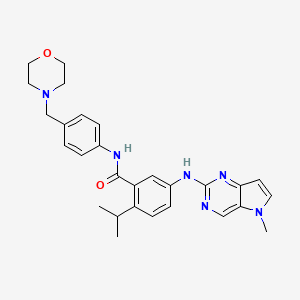
The existing drug CB-5083 serves as our starting point:
- VCP inhibitor that reached Phase I trials
- Discontinued due to off-target effects
- Provides a molecular scaffold to improve upon
3. Generate Novel Molecules
BioNeMo MolMIM generates 100 new molecular structures:
- Uses the same AI architecture as text generators
- But writes molecular structures (SMILES notation) instead of sentences
- Each molecule is a variation designed to improve on the seed
4. Predict Binding
BioNeMo DiffDock simulates molecular docking:
- Predicts the 3D pose of each molecule in the binding pocket
- Calculates binding affinity (docking score)
- Score < -8.0 kcal/mol = excellent binding
5. Score Drug-Likeness
RDKit evaluates whether molecules could work as oral drugs:
- Lipinski's Rule of Five — Size, solubility, permeability
- QED Score — Quantitative Estimate of Drug-likeness (0–1)
- Threshold: QED > 0.67 indicates good drug potential
Results
From a real Cloud NIM inference run (30 generated, 27 passed chemistry QC, 27 docked against PDB 5FTK):
| Metric | Value |
|---|---|
| Generated molecules | 30 |
| Pass chemistry QC | 27 (90%) |
| Successfully docked | 27 (100%) |
| Top candidate QED | 0.906 |
| Top candidate docking | -5.113 |
| Top composite score | 0.8846 |
Top Candidate vs. Original Drug
| Metric | CB-5083 (Original) | AI Candidate (VCP-NIM-021) |
|---|---|---|
| Drug-likeness (QED) | 0.62 | 0.906 |
| Docking score | -8.1 | -5.113 |
| Composite score | 0.64 | 0.8846 |
| Improvement | — | +38% |
Technology Stack
Deployment Modes
Stage 3 supports three NIM deployment strategies:
| Mode | Config | Best For |
|---|---|---|
| Cloud | NIM_MODE=cloud |
DGX Spark (ARM64), no local GPU needed |
| Local | NIM_MODE=local |
x86_64 systems with NVIDIA GPU |
| Mock | NIM_ALLOW_MOCK_FALLBACK=true |
Development and demos |
Cloud mode uses NVIDIA's hosted BioNeMo APIs at health.api.nvidia.com, enabling the full pipeline on ARM64 platforms like DGX Spark where the x86-only NIM containers cannot run natively. Set NIM_MODE=cloud and provide your NVIDIA_API_KEY from build.nvidia.com.
How Scoring Works
Each candidate is ranked by a composite formula:
- Generation Confidence — How well the AI generated the structure
- Binding Strength — Predicted affinity to the target (docking score)
- Drug-Likeness — QED score from RDKit
Important Context
These are computational predictions — promising starting points for laboratory testing, not finished medicines.
Real drug development requires:
- Synthesis — Actually making the molecules
- In vitro testing — Cell-based assays
- In vivo testing — Animal models
- Clinical trials — Human safety and efficacy
- Regulatory approval — FDA or equivalent
What this pipeline does is collapse the first step — identifying targets and generating candidates — from months of work into hours.
The Output
Stage 3 produces a ranked list of 100 drug candidates:
Rank  SMILES                          Docking   QED    Score
----  ------------------------------  --------  -----  -----
1     CC1=CC=C(C=C1)C2=CN=C(N2)...   -11.4     0.81   0.89
2     COC1=CC=C(C=C1)N2C=NC3=C2...   -10.8     0.78   0.86
3     CC(C)NC(=O)C1=CC=C(C=C1)...    -10.2     0.79   0.84
...
Each candidate includes:
- SMILES notation — Machine-readable molecular structure
- 2D structure image — Visual representation
- Docking score — Predicted binding affinity
- QED score — Drug-likeness
- Lipinski violations — Rule-of-five compliance
- Composite rank — Overall score
Full Pipeline Summary
flowchart LR
    S0["Stage 0\nData Acquisition\nOne-time"]
    DNA["Patient DNA\n200 GB FASTQ"]
    S1["Stage 1\nGPU Genomics\n2–4 hours"]
    VCF["11.7M\nVariants"]
    S2["Stage 2\nEvidence RAG\nMinutes"]
    TGT["VCP\nDrug Target"]
    S3["Stage 3\nDrug Discovery\n8–16 min"]
    OUT["100 Ranked\nCandidates"]

    S0 -.->|"~500 GB downloaded"| DNA --> S1 --> VCF --> S2 --> TGT --> S3 --> OUT

    style S0 fill:#374151,stroke:#6B7280,color:#d1d5db
    style DNA fill:#B3E5FC,stroke:#0288D1
    style S1 fill:#76B900,stroke:#5a8f00,color:#fff
    style VCF fill:#FFE082,stroke:#FFA000
    style S2 fill:#00B4D8,stroke:#0077B6,color:#fff
    style TGT fill:#FFE082,stroke:#FFA000
    style S3 fill:#8b5cf6,stroke:#7c3aed,color:#fff
    style OUT fill:#76B900,stroke:#5a8f00,color:#fff
Total time: Under 5 hours from raw DNA to drug candidates (plus one-time Stage 0 data acquisition).